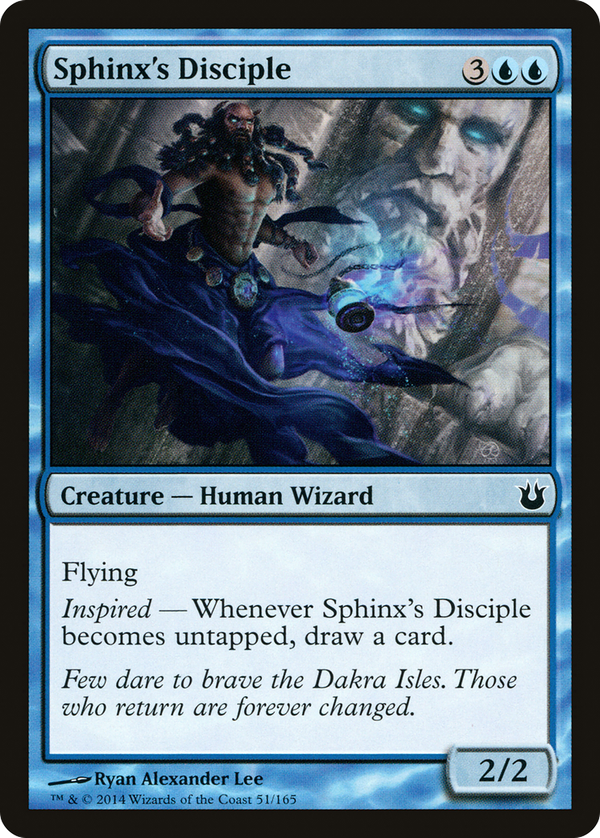
Sphinx's Disciple


Most of the Inspired cycle pointed its payoff at a tapped-out opponent, converting a connected hit into disruption or pressure. This one keeps the reward selfish: it just draws you a card. Evasion is what makes that loop cohere. A flier sidesteps ground blockers entirely, so the attack-and-survive cycle that earns the trigger becomes reliable rather than aspirational: swing in the air, connect or get ignored, and collect a card when the creature straightens back out on your next turn. The delay is the cost. The creature has to tap, usually by attacking, then live through a full turn cycle (exposed to removal, blockers, and tap-down effects) before it pays out. That built-in lag is the balancing lever: it keeps a repeatable card-advantage engine stapled to a fragile five-mana 2/2 rather than something the format would have to answer. Inspired never produced a defining card, in part because the mechanic demanded creatures attack into open boards to earn their value, a tension that always favored evasion over stats. Sphinx's Disciple resolves that tension about as cleanly as the mechanic allowed, and the flying does more real work than the rate on the body suggests.