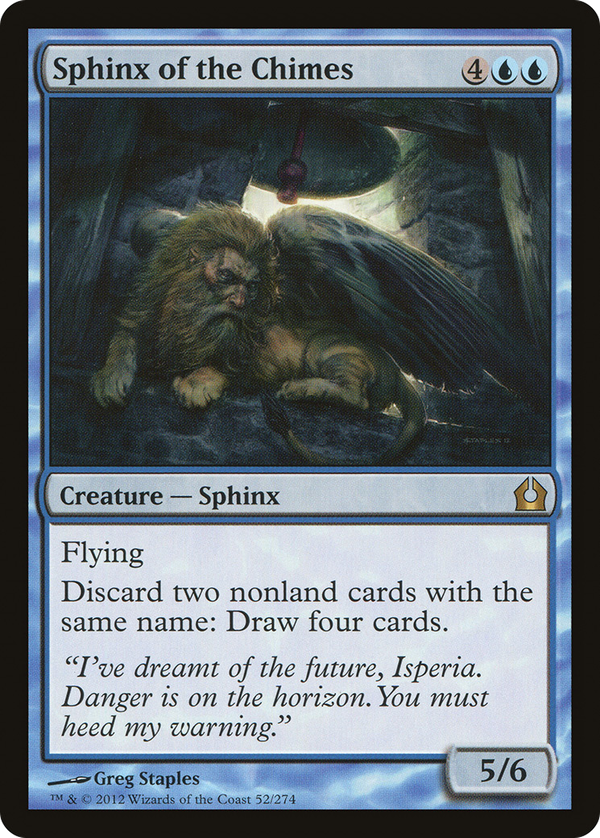
Sphinx of the Chimes


The activated ability reaches back to one of the deepest constraints in deck construction: the four-of rule. Discarding two nonland cards with the same name to draw four is a clean two-for-four, net positive card advantage, but the cost is structural rather than situational. You cannot pay it from a singleton-shaped deck; the ability presumes you have already committed to running multiples, which means it slots into shells heavy on duplicated counterspells, removal, and card-draw. The discard is the wrinkle that turns dead pairs into fuel: a flooded hand holding two redundant board wipes becomes a refill rather than a liability, and the cards leaving your hand are precisely the ones you were least excited to cast twice. Because there is no tap symbol on the cost, the ability fires at instant speed and never asks the body to choose between attacking and refueling: a 5/6 flyer can swing in and still hold up the draw on the same turn, since paying it costs only cards in hand, not the creature's combat. That body is doing quiet work too. A 5/6 in the air survives most damage-based removal and most combat math, so it presses a real clock while the ability rebuilds the hand behind it. It is a payoff that asks a deckbuilder to lean into redundancy rather than diversity, an unusual ask in a game whose construction usually rewards spreading answers across different effects.