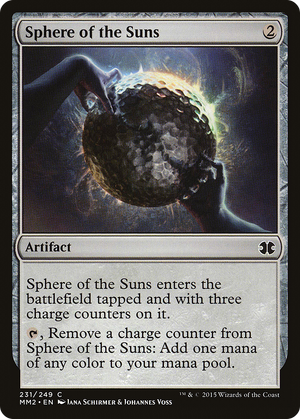
Sphere of the Suns

Three uses, then it is gone. The charge counters are what separate this from the perpetual fixing of a Manalith or a guildgate: you get exactly three rainbow taps before the rock becomes a blank artifact taking up space. That rationing is the trade made to print a two-mana, any-color source: rather than the per-activation life cost of a painland or the recurring tempo bleed of a slow source, the drawback is a fixed budget you spend down across the early turns. The entering-tapped clause pushes the smoothing back a turn, which is the real front-end cost in a fast game: you pay for the flexibility before you get to use it. What the counters buy is colored mana for the opening turns, precisely when a greedy multicolor manabase is most likely to stumble, and the source stops mattering exactly when the game has gone long enough that you have drawn into your real lands. That makes it a bridge, not a foundation. A deck leaning on it is borrowing fixing against the first few turns and paying it back by mid-game, which is either exactly what a color-hungry curve needs or a dead draw once the counters run dry. The design sits a step removed from the single-use chromatic rocks (Chromatic Sphere and Chromatic Star, each cashed in once and sacrificed for a card): same generosity, metered out instead of spent all at once.
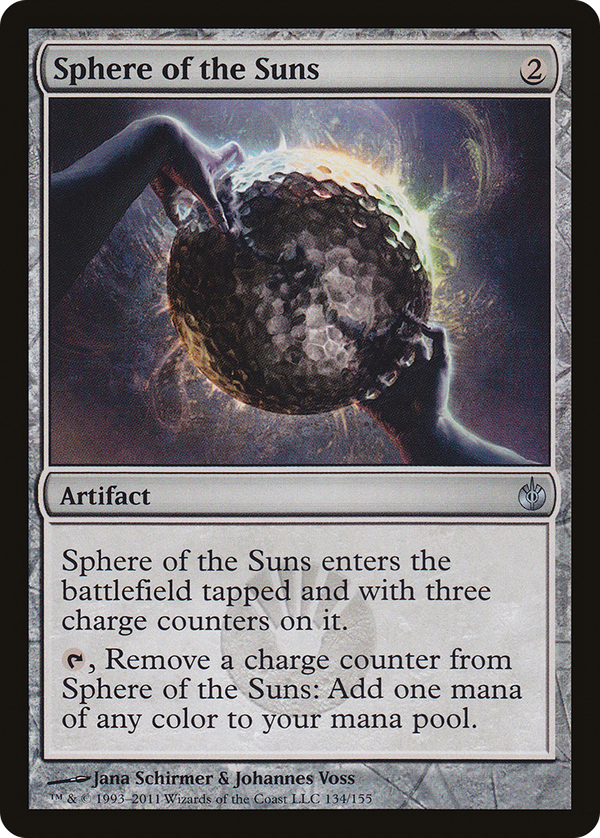
Rules text
 , Remove a charge counter from this artifact: Add one mana of any color.