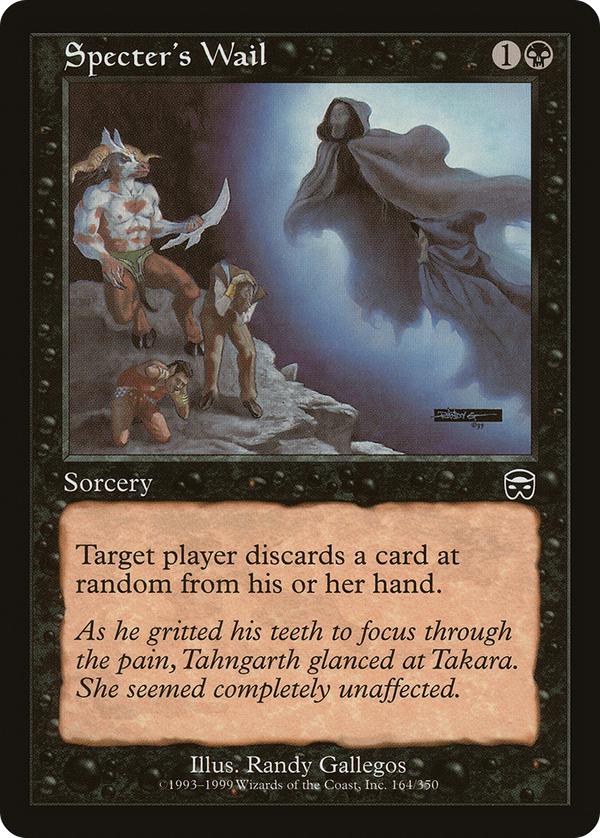
Specter's Wail


Random discard buys efficiency by giving up sight: you pay two mana and let the dice decide which card leaves the opponent's hand, trading the targeted certainty of a Coercion for a cheaper rate. The payoff is that the card stops caring how good the opponent's hand looks. Against a player clutching a single threat, the strip is a sure thing; against a player whose hand is wide and live, the variance barely matters, because anything you take is a card they wanted. Only the awkward middle (a hand where one card matters and three don't) gives the randomness room to disappoint you. That structural trade is why black has always carried two parallel hand-attack families: the targeted line (Duress, Thoughtseize, Coercion) that pays a premium to choose, and the random line (Hymn to Tourach and its kin) that accepts variance for efficiency. This sits firmly in the second camp, a one-shot at the cheap end of that trade, from an early era when low-cost discard was the connective tissue of dedicated stripping decks, before later disruption suites made targeted hits affordable enough to crowd out the random ones. The "target player" clause is the quiet wrinkle: it can point at yourself, though random discard makes that a gamble rather than a tool, since you cannot promise the card pitched is the one you wanted gone.