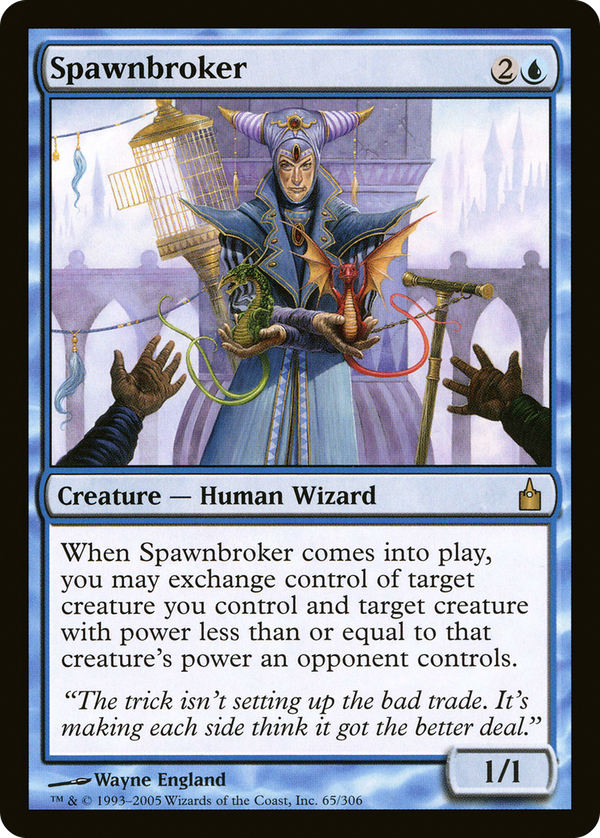
Spawnbroker


The fantasy that sells this card is the steal; the constraint that defines it is the swap. You give to take. Most control-changing effects of its era were one-way thefts that punished you only by costing mana: Control Magic sat on the board and the cost was tempo, not parity. Here the exchange is mutual, and the power clause runs the other direction from what an aura promises. The creature you seize must have power less than or equal to the one you hand over, so you cannot trade a token for a finisher. What you can do is trade across at the same power line and come out ahead on everything power does not measure: give away a vanilla bear, take their evasive flier; surrender a creature with a downside, claim one with vigilance or a useful trigger. The exchange rewards a board where your biggest body is also your most disposable, parked next to something whose power matches but whose abilities you would rather own. The 1/1 frame that delivers it is fragile enough that the swap has to earn its keep on arrival, and the trigger is a may, so a board with nothing worth trading lets it whiff into a plain 1/1 rather than forcing a deal that helps your opponent. It is a Wizard built to redistribute combat, not to win it, for players who treat a board state as a thing to be reshuffled rather than simply attacked with.