Souls of the Lost


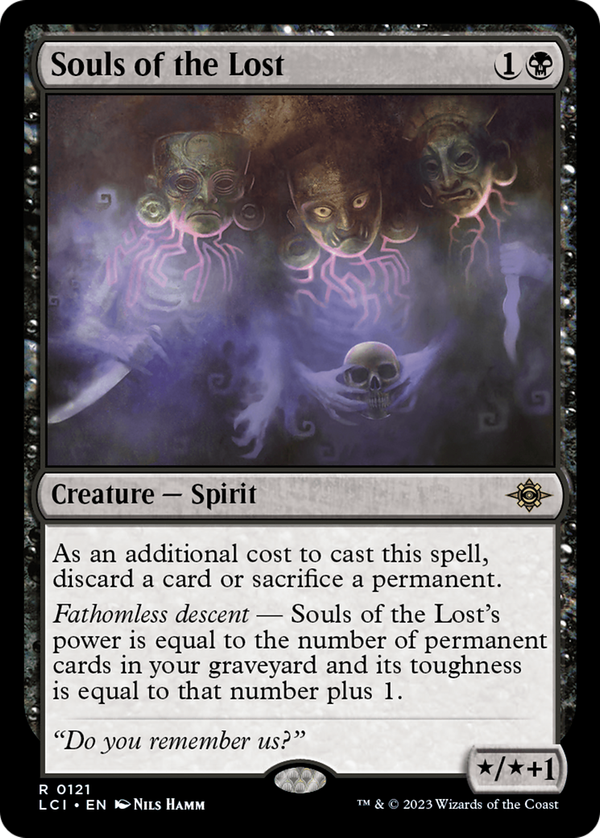
Fathomless descent has an elegant self-consistency built into it here: often, whatever you pay to cast the Spirit becomes fuel for the size it reads. Because the additional cost demands a discarded card or a sacrificed permanent, and the power counts permanent cards in your graveyard, the price and the payoff push in the same direction. Pitch a land, sacrifice a spent artifact, feed a dead creature to the yard, and the same motion that paid the toll enlarges the body it produces. That collapses a tension most graveyard-matters creatures leave open: you usually choose between stocking the yard and putting threats on the board, where this asks for one action that does both. The two-mana line, then, is a floor rather than a rate. The Spirit is only as large as the work already done, which suits decks that were grinding permanents into the graveyard regardless. The toughness-plus-one clause quietly matters, letting it survive symmetrical board sizing and trade up rather than even. The counting restriction is what keeps it from running away: instants and sorceries in the yard contribute nothing, so a spell-heavy graveyard leaves a fragile creature and an empty one leaves a 0/1 that cost you a card. A self-fueling threat scaled to the exact resource its casting spends is a tidy bit of loop logic for a two-drop, and it demands a deck already built around discarding and sacrificing to earn the payoff.