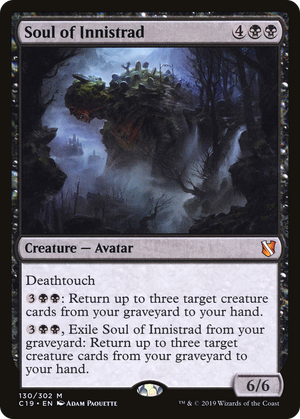
Soul of Innistrad


The two-stage design here is subtler than it looks: a 6/6 deathtouch blocker already walls off attackers, but the same six-mana frame doubles as a recursion engine you fire repeatedly while it stands. Each activation buys back up to three creature cards to hand, so the card is a threat and a value faucet at the same time, not in sequence. The graveyard clause is the safety net, not the payoff. It is a one-shot that exiles the card from the bin as part of the cost, refunding three creatures one final time after the body has died. That separation matters: the repeatable engine is gated behind staying alive, and dying grants exactly one more refill before the card is gone for good. The recursion returns cards to hand rather than the battlefield, which is the restraint that keeps a six-mana 6/6 from rebuilding the board on its own: no free reanimation, just steady card advantage paid for in five-mana chunks. Both abilities target creature cards in your graveyard, so the whole plan is exposed to disruption in the same way: an opponent who exiles those targets in response to the activation simply denies the return, and a bin emptied ahead of time leaves nothing to buy back at all. As an entry in black's long fixation on creatures that keep working after death, it leans toward slow inevitability rather than combo, grinding attrition by refusing to run out of bodies to recur.
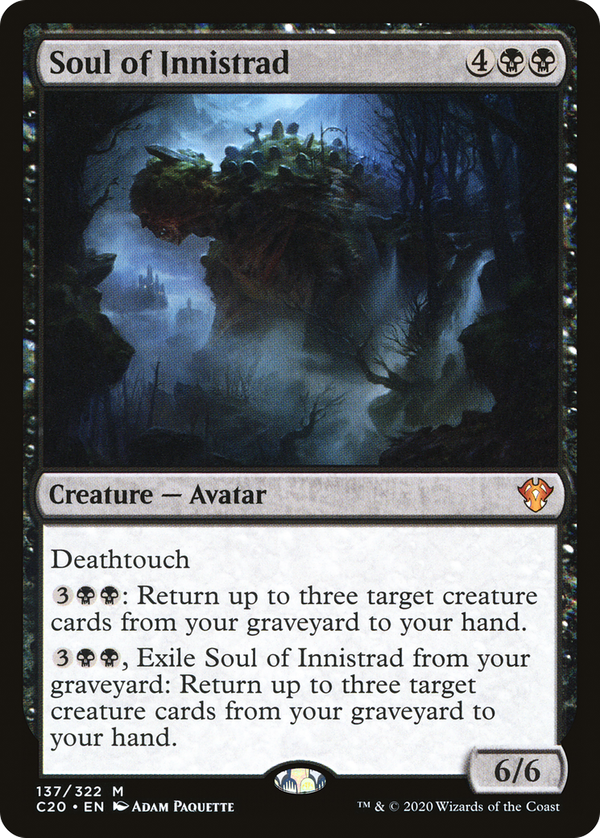
Rules text
 : Return up to three target creature cards from your graveyard to your hand.
, Exile this card from your graveyard: Return up to three target creature cards from your graveyard to your hand.
: Return up to three target creature cards from your graveyard to your hand.
, Exile this card from your graveyard: Return up to three target creature cards from your graveyard to your hand.