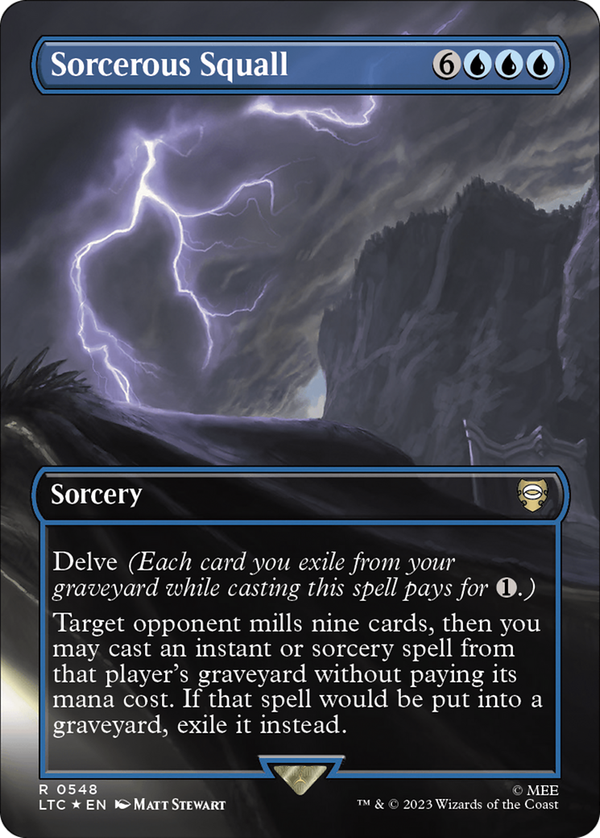
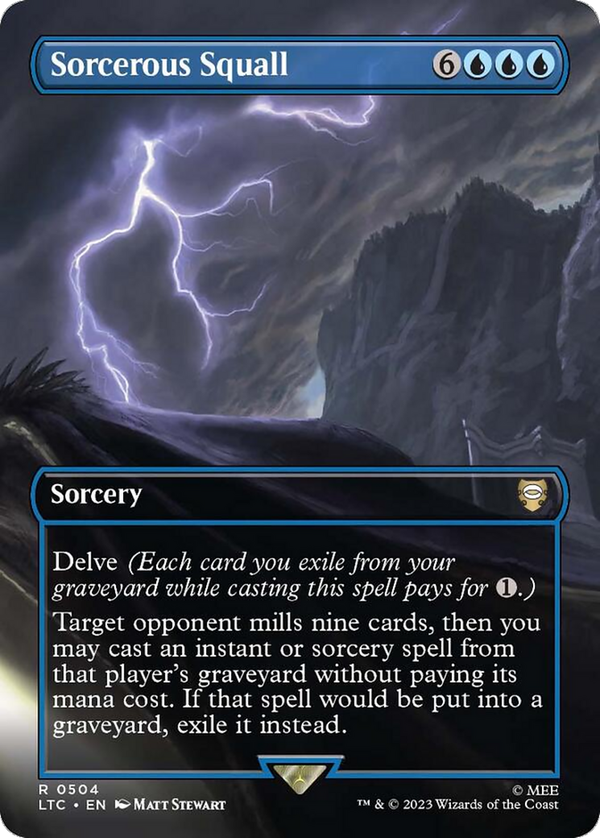
Sorcerous Squall


The theft is the payoff; the mill is only the excavation you do to reach it. Nine cards leave an opponent's library and land in their graveyard, and from that graveyard you get to cast the best instant or sorcery they own, mana-free, then exile it so it never loops back. That inverts the usual mill-as-attrition logic, where filling an opponent's yard is a cost you pay to grind them out. Here it is prospecting: you are digging through someone's spells to find the one worth stealing. Delve is the discount that makes the nine-mana sticker a fiction, but it draws only on your own graveyard, so the two halves of the card pull in opposite directions across the table. The delve wants your yard stocked before you cast; the payoff wants an opponent's spell count high enough that milling nine turns up something worth the free cast. Neither appetite feeds the other, which is the tension worth building around: you need your own graveyard flush to make the delve real rather than notional, and you need to point the spell at a player whose deck is dense enough with removal, wraths, or tutors to justify the raid. The exile clause on the stolen spell is what keeps it a single strike rather than a recursion engine: cast it, resolve it, gone.
Rules text
 .)
Target opponent mills nine cards, then you may cast an instant or sorcery spell from that player's graveyard without paying its mana cost. If that spell would be put into a graveyard, exile it instead.
.)
Target opponent mills nine cards, then you may cast an instant or sorcery spell from that player's graveyard without paying its mana cost. If that spell would be put into a graveyard, exile it instead.