Soldevi Sentry

Regeneration that pays an opponent for the privilege: a quirk of Alliances design that treated drawback as a balancing knob rather than a flat downside. A 1/1 that can survive nearly anything for a single mana, repeatedly, is a problem the era did not want unchecked, so the cost is denominated in a chosen opponent's resources instead of your own. The shape of the ability is precise about the order of events. You pay to set up a regeneration shield, and only when that shield actually saves the Sentry from destruction does the chosen player get the option to draw a card. The regeneration is not contingent on that draw; refusing it does not let combat through. The "may" sits downstream of the shield going up, which means the tax is real but the survival is guaranteed the moment you pay. Against a single opponent the math is brutally honest: you are buying durability and feeding their hand to do it, and they will rarely decline a free card. With more seats at the table the choice of target becomes the whole exercise, since you route the gift to whichever player's draw step matters least or whose hand is already glutted. This belongs to the Alliances tradition of saddling efficient effects with friction that benefits the very players you are stalling, an externalized tax paid out of someone else's library rather than your own board. As a piece of game design it is a small, exact statement about how mid-90s development priced near-indestructibility: not by raising the mana, but by handing a rival a card every time you flinch.
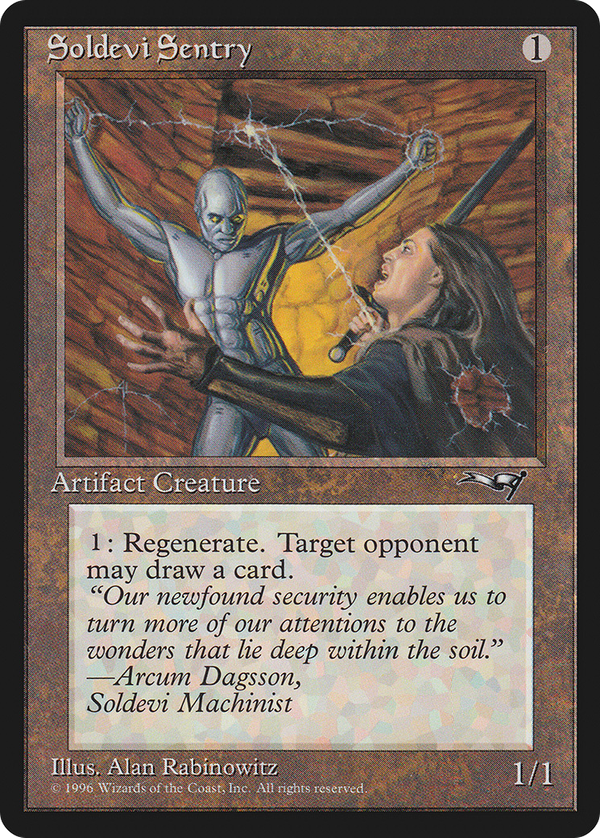
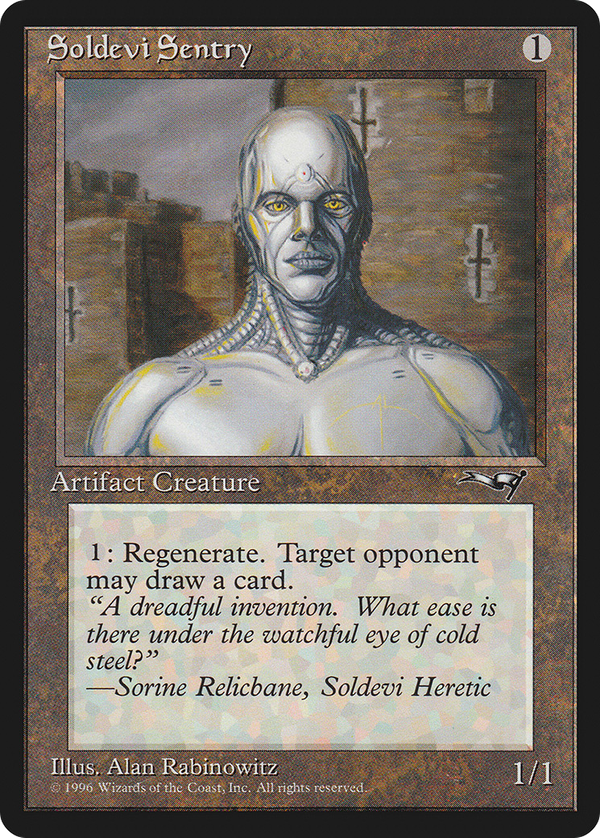
Rules text
: Choose target opponent. Regenerate this creature. When it regenerates this way, that player may draw a card.