Snap Judgment


Five mana buys an instant whose entire text is a rules joke that the opponent gets to write the punchline to. Resolve it and the player who wins the current game wins the whole match, collapsing what is normally a best-of-three into a single decisive game. The trap lives in the parenthetical, where a footnote about concession becomes the card's undoing: because a player may concede at any time, and because conceding while this spell is on the stack means it never resolves, an opponent staring down the payoff can simply give up the current game to deny you the match. The spell only rewards whoever wins the game it is cast in, so a voluntary loss fizzles it entirely, and you have paid five mana for nothing. That circular defeat is the design. The cycling clause quietly admits it; one mana to pitch the card concedes that nobody holds up five mana for a spell any conceding opponent can wave away. Cards built like this exist to prod the tournament rulebook rather than the battlefield, reading less like something you would ever resolve than like a hypothetical handed to a judge at three in the morning: what happens when someone concedes in response to the card that says the winner wins?
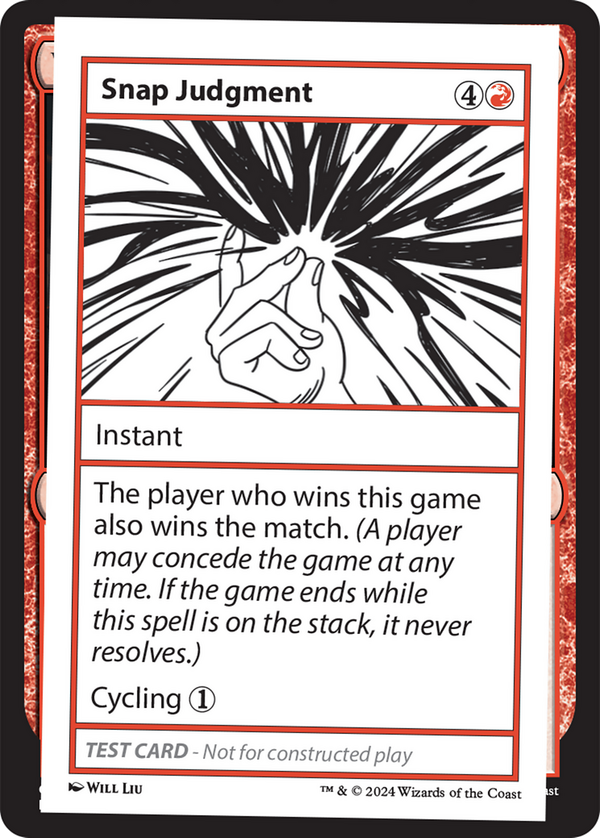
Rules text