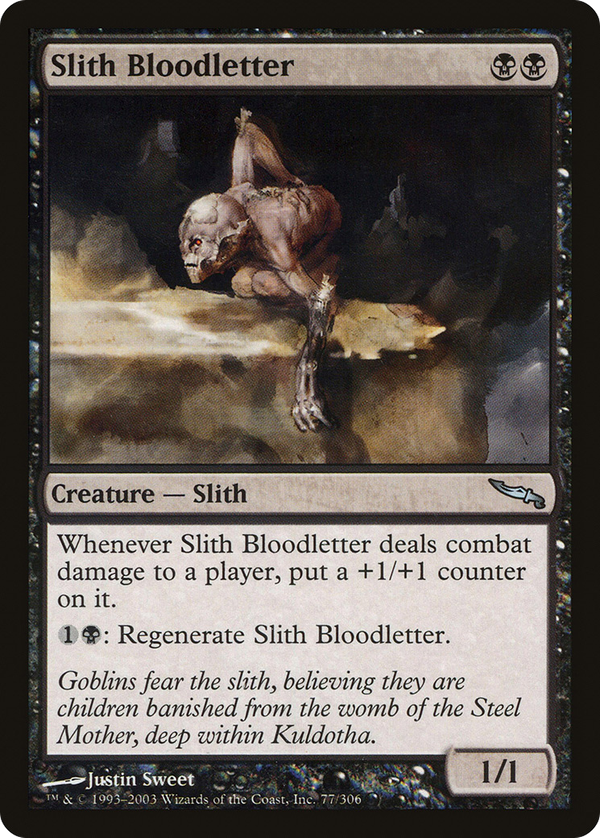
Slith Bloodletter

The Slith mechanic answered a recurring problem with early aggression: how do you make a 1/1 worth attacking with on turn two, when the board is empty and the opponent has no blockers yet? The reward is tied to connection rather than deployment. Each unblocked hit stacks a +1/+1 counter, so a creature that starts as chump-fodder grows into a real clock for every turn the lane stays open. The double-black cost slots this one toward the front of the curve among its siblings, and regeneration is the wrinkle that sets the Bloodletter apart from its colorless and white cyclemates: instead of leaning on evasion to slip past blockers, it can pick a fight, survive the trade, and keep the counters it has already banked. That rewrites the math on attacking into open mana. A defender who blocks expecting a clean one-for-one finds the creature shrugging off lethal damage and coming back next turn at full accumulated size. The counters never come from being blocked, so it does not grow on the turn it stops getting through; what regeneration buys is permanence, the refusal to surrender what it has earned. The design tension is that a snowball threat collapses the moment it can no longer connect, and black answers that by paying mana to keep its growth on the board. Where the other Sliths bet on evasion or sheer speed, this one bets on staying alive long enough to swing again.
Rules text
 : Regenerate this creature.