Sin, Spira's Punishment




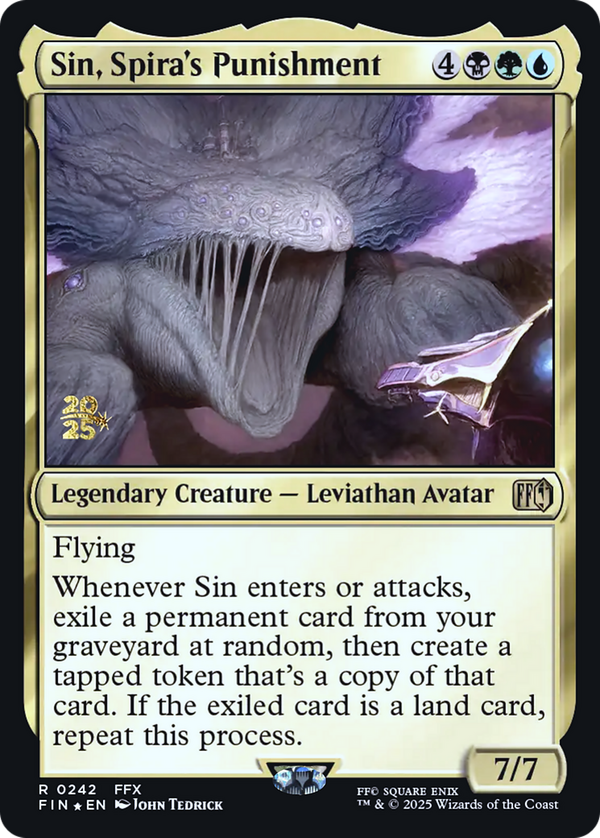
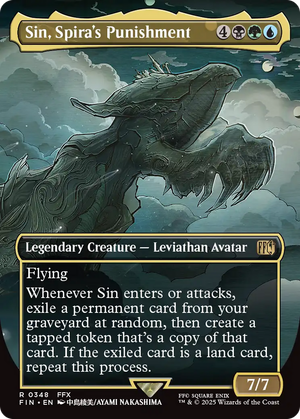
The recursion clause is built around a randomness that most graveyard payoffs work hard to avoid. Where black and blue reanimation typically lets you pick the target (Reanimate, Animate Dead, the whole tradition of choosing your best dead thing), this one reaches into the graveyard blind and copies whatever it grabs. The tension that makes the design tick is the land clause: hit a land, and the process repeats, so a graveyard stocked with fetchable duals turns a single trigger into a chain that only stops when it lands on a nonland permanent. That inverts the usual deckbuilding instinct. Instead of filling the yard with a handful of premium bombs and praying, you want density: enough lands to keep the chain alive, enough spread of cheap and expensive permanents that any hit is fine and some hits are great. The tokens arrive tapped, which quietly pays for the value by keeping the copies out of the fight on the turn they show up. And because the trigger fires on both entry and every attack, the seven-mana body is not a one-time payoff but an engine that grows the board each combat, feeding itself so long as the graveyard holds cards. It is a reanimator finisher that has traded the certainty of selection for the volume of repetition, and the whole build-around lives in that trade.