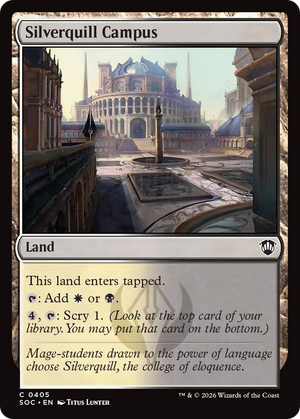
Silverquill Campus
The Orzhov entry in the tapland cycle that gave every two-color pair a fixer with a late-game mana sink. The activated scry is the whole design premise: these lands exist to keep flooded hands relevant, converting excess mana into card selection once your curve has run out. That is the trade being made. You pay a full tempo turn up front (it enters tapped, no way around it), and in exchange the land stops being a dead draw in the twentieth turn of a grind. The four-mana price tag on the scry is deliberately steep, high enough that you never activate it in the early game when tempo is scarce, low enough that it comes online naturally once the board has stabilized. Compared to the older bounce-land and karoo designs that tried to solve the same "lands are boring topdecks" problem by generating extra mana, this generation of duals went the other way: instead of accelerating you, they filter for you. The result is a fixer that asks nothing of your deckbuilding beyond running the two colors it taps for, and rewards patience rather than punishing greed. Unspectacular by intent, and that restraint is exactly why the cycle became a default rather than a build-around.
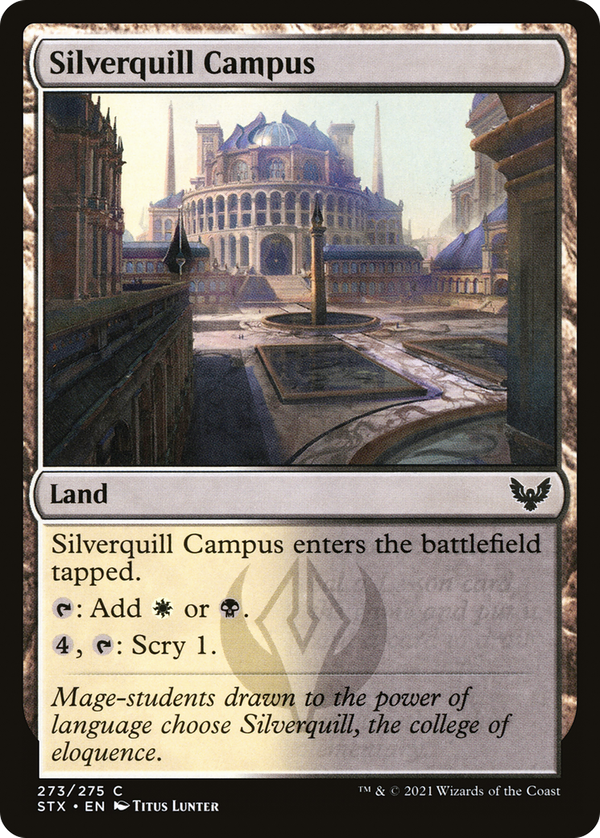
Rules text
 : Add
: Add  or
or  .
.
 , : Scry 1. (Look at the top card of your library. You may put that card on the bottom.)