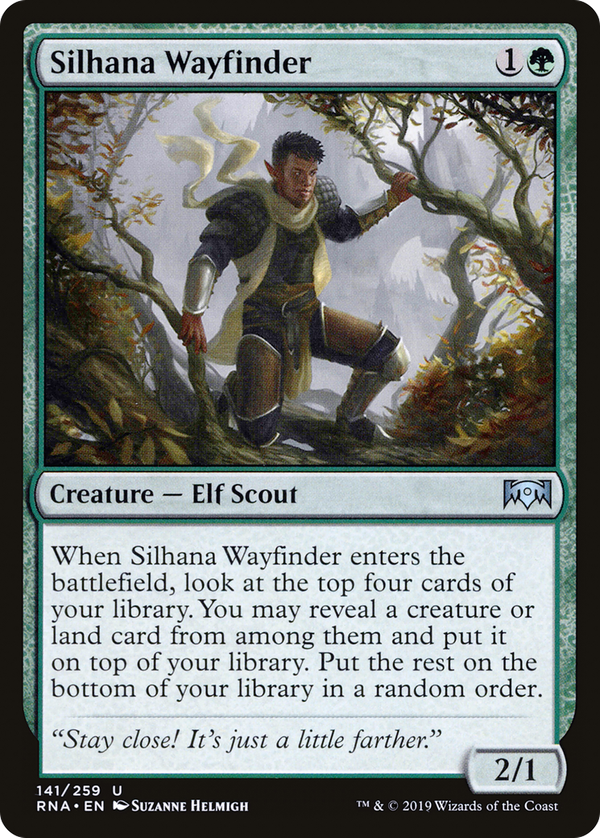
Silhana Wayfinder


The design lineage here runs back to card-selection dorks that trade a body for library sculpting: a two-drop that filters four deep and tucks the one card you want onto the top, sending the chaff to the bottom rather than the graveyard. The restriction to creatures and lands is the line that draws the boundary; it will not find you a burn spell or a wrath, only bodies and mana. That narrowing buys the depth. Four cards is a wide window for a 2/1, so the trigger only ever hands you the pieces a green midrange or ramp deck actually wants, never the interaction that would make it a universal roleplayer. The tuck-to-top clause carries a real cost that scry does not: you commit the found card to your very next draw, which stings when a live top would have served you better than a land you did not yet need. Sending the rest to the bottom in random order is the tax that denies you a cleanly stacked library. As a body, the 2/1 is fragile enough that this reads as a spell first and a creature second, but the elf-scout typing gives it a home in decks built to reuse the trigger through blink or recursion, where the four-card look stops being one-time smoothing and becomes a repeatable engine.