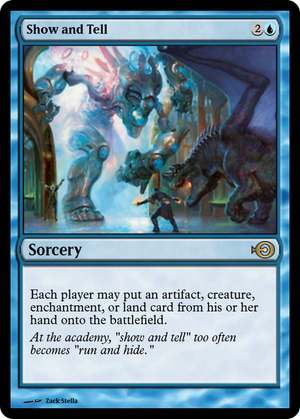
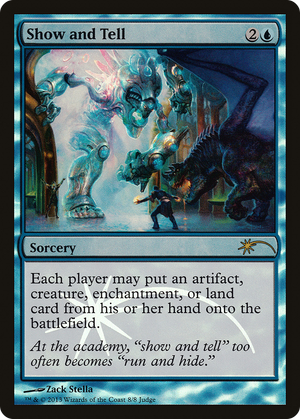
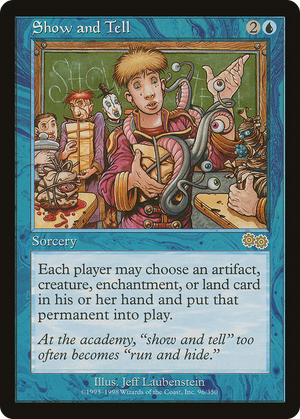
Show and Tell


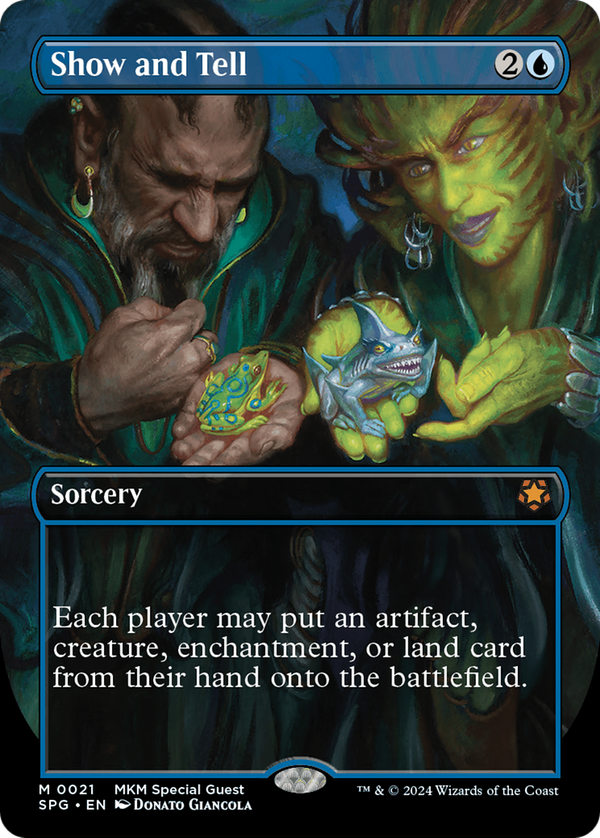
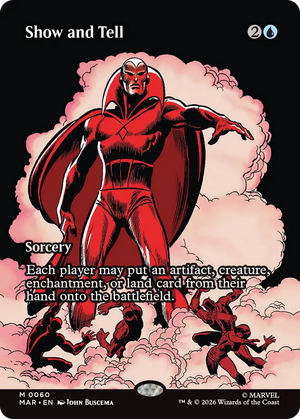
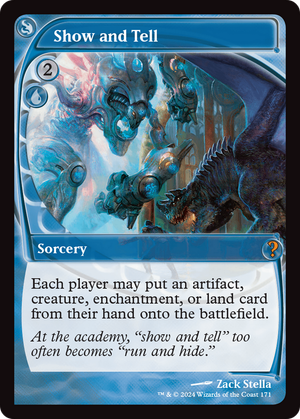
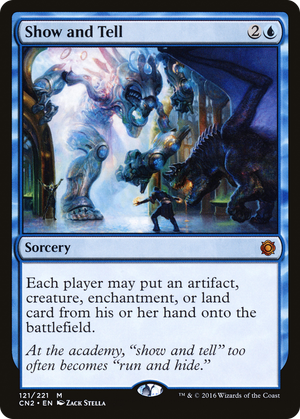
Both players get the same offer, and the deck built around the card has spent every other slot ensuring its half of the deal ends the game while the opponent's half is, at best, a polite gift. Three mana skips the cost of something that should never touch the battlefield this early: Emrakul, the Aeons Torn arriving a dozen turns before its mana would allow, or Omniscience flipping the rest of a hand onto the table. The "each player may" clause reads as a fairness valve and functions as a coin-flip the caster has already weighted, because building the board where the mirror-image free permanent does not matter is exactly the work the archetype does. What has kept it relevant across decades of cheat-it-into-play strategies is how little it asks: no graveyard to fill, no creature to sacrifice, no setup beyond holding a fat permanent. It is reanimation-adjacent without being reanimation, opening a door for any artifact, creature, enchantment, or land in hand rather than pulling from a yard (planeswalkers and battles are quietly excluded, a real limit on the toolbox). The symmetry is the price of that permission, and the entire history of the card is one long argument about how to make the opponent's free permanent irrelevant before they ever untap with it.