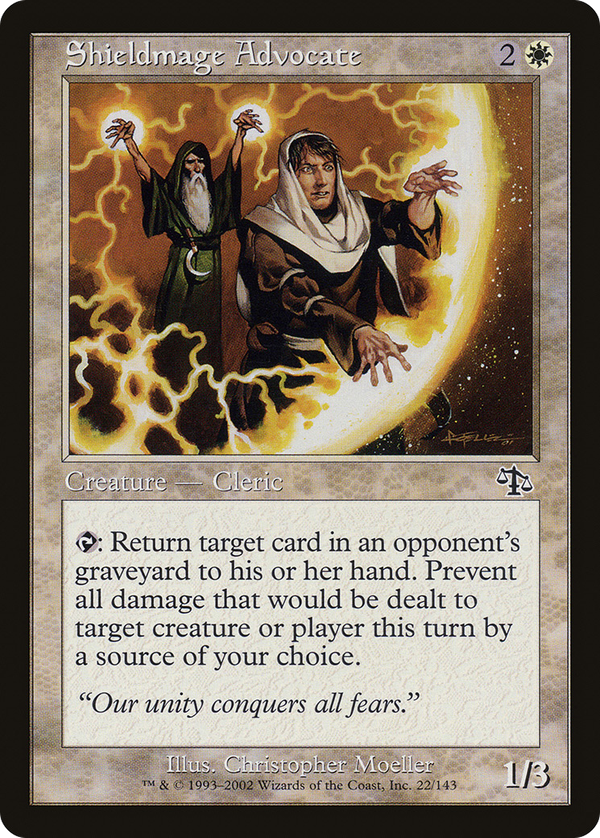
Shieldmage Advocate


Two effects yoked into one tap ability, and they pull in oddly different directions. The damage prevention is the part a defensive deck wants: a repeatable fog that you can aim at a single creature, a player, or your own attackers, restitching one combat step every turn. The graveyard return is the price, and it is a strange one: you are handing an opponent a card back, not gaining anything yourself. That cost was clearly meant as a control valve. Free repeatable prevention would have been oppressive, so the design tucked a small concession to the opponent into the same activation, the way a Cleric mercy is folded into a Cleric ability. The activation therefore asks you to prevent damage you genuinely cannot afford to take, since each use also returns a piece of your opponent's spent resources. Against a graveyard-reliant strategy, though, the symmetry inverts: a deck that wants cards stocked in its graveyard does not want them pulled back to hand, so the return stops being a gift and becomes a slow form of disruption. As a body it is built to survive: a 1/3 that wants to sit back and tap each turn rather than attack into anything. The card sits in a small early-era family of effects that bargain with the opponent's graveyard as part of their function, a thread that white as the actor has rarely revisited since.
Rules text
 : Return target card from an opponent's graveyard to their hand. Prevent all damage that would be dealt to any target this turn by a source of your choice.