Shatter Assumptions


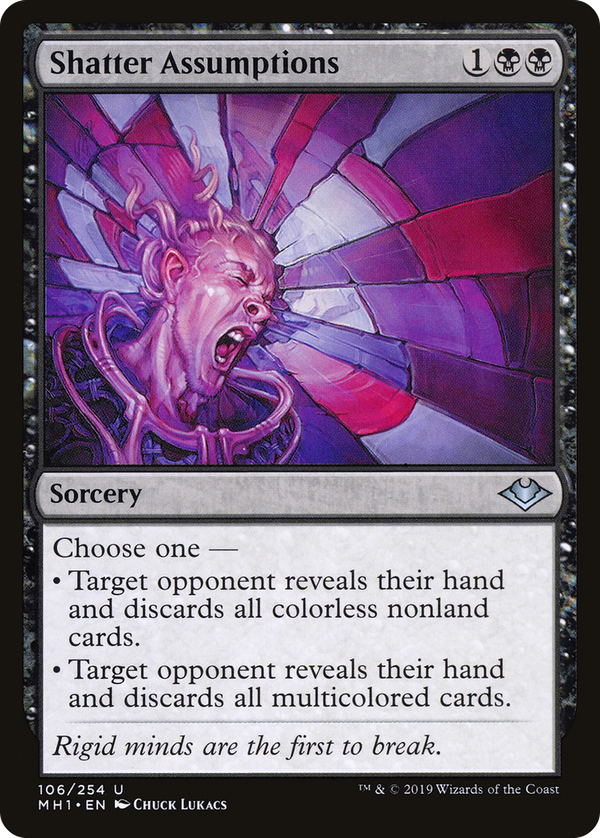
Most targeted discard reads the opponent's hand and lets you pluck the single card that hurts most. This instead names an axis and takes everything sitting on it, which means it can whiff to zero or strip four cards at once depending entirely on the color-pip geometry of the deck across the table. The two modes are surgical rather than general: one names colorless nonland cards, punishing the artifacts, Eldrazi, and colorless payoffs that fill a manabase or anchor an engine; the other takes every gold card, gutting a strategy whose whole identity lives in overlapping color requirements. That conditionality is the price of the ceiling, and here the price is real, because the modal choice is made on cast, before the opponent reveals anything. You are not diagnosing the hand and then selecting the live axis; you are betting on which axis is live based on what you already know about the deck, then finding out whether the bet paid. Against a two-color list built on clean single-pip spells it does nothing; against the right target it is a one-card blowout no amount of card selection recovers from. What distinguishes it from general-purpose disruption is that the variance is not random but knowledge-priced: it rewards a pilot who has already decided what problem they are solving and who understands the opposing deck well enough to name the axis blind. It belongs to the school of hate-piece discard, the kind that punishes a strategy for concentrating its power along a single color line.