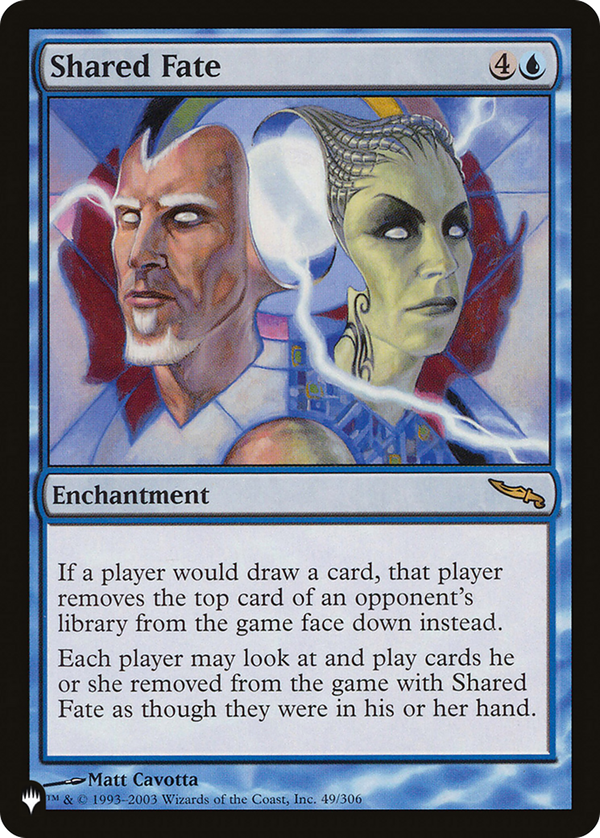
Shared Fate


Draws from your own library stop entirely: every card you would have drawn becomes a card stolen face down from an opponent, playable only by you. The enchantment rewires the most fundamental loop in the game (the draw step) into a theft engine that runs in both directions, since each player is mining someone else's deck rather than their own. That symmetry is the trap and the appeal. It looks even, but the player who built around it controls the variables: you can pack your deck with effects that punish a thin or unfamiliar hand, while your opponent is forced to win on resources they never chose and cannot anticipate. It also quietly dismantles one of the oldest non-combat win conditions, because milling becomes incoherent and decking out routes change shape when nobody draws from their own library at all. The design belongs to an era that prized big, table-altering rules rewrites over incremental card advantage; its kin in spirit are the cards that change how everyone draws, not the ones that simply draw more. The cost of admission is the chaos itself: you hand opponents access to your library every bit as fully as you raid theirs, and the games that result rarely resemble anything either deck was assembled to do.