Shardless Outlander

The whole point of a landcycler is that it almost never gets cast for its printed cost. The seven-mana Construct is the ceiling, not the plan: for two mana and a discard it becomes a basic of your choice, smoothing an early draw exactly when you would rather not be holding a top-end body you cannot afford. That is the trade every landcycler has always run: pack a card that plays as land on the turns you are short and as a threat on the turns you are flooded. The distinction here is the payoff at the top. A 6/5 with trample is a real finisher, not the token 3/2 that most cyclers hard-cast into, so the games that go long reward the option instead of embarrassing it. The card asks nothing of the deckbuilder beyond the willingness to run it: fixing when you need land, a beater when the game grinds, and never a dead draw in between. That flexibility is where the whole value sits, which is why the enormous cost reads as generosity rather than a tax. You are never really paying seven; you are paying two to fix your mana and keeping the option to pay seven open for the games that make it worth the mana.
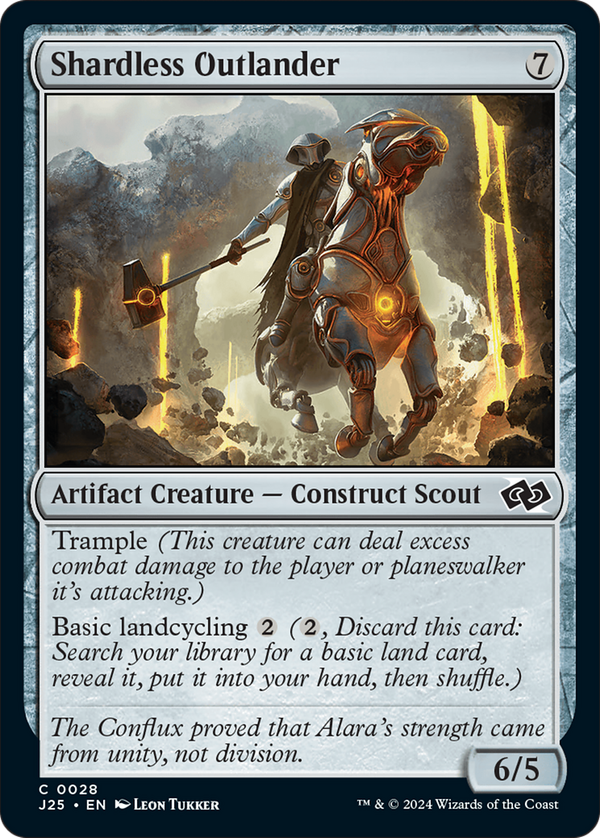
Rules text
 (, Discard this card: Search your library for a basic land card, reveal it, put it into your hand, then shuffle.)