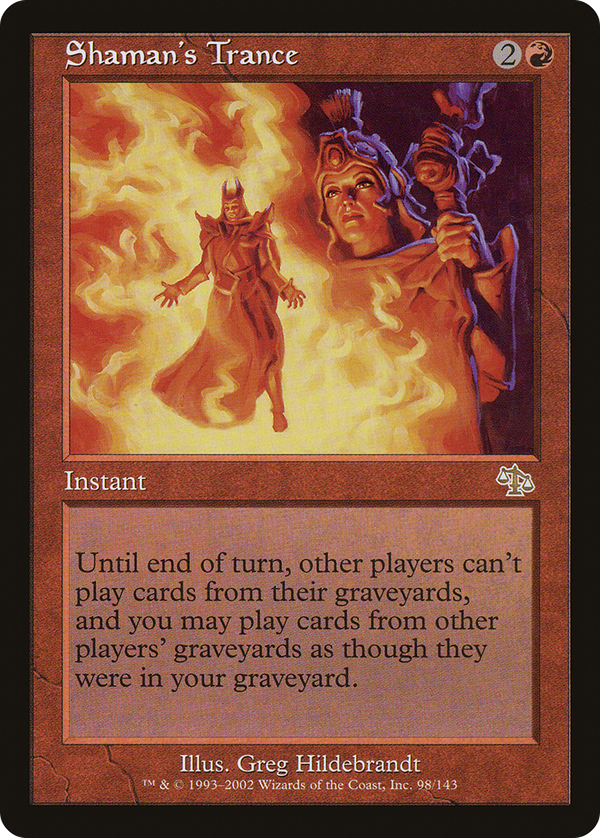
Shaman's Trance


Graveyard recursion was a black-and-blue affair in the early years: black raised dead, blue drew from the bin, and red mostly burned things to ash. This instant is the oddball red got instead, and it reframes the graveyard not as a personal resource but as contested territory. For one turn, every opponent's graveyard becomes yours to use while none of them can touch their own. The design idea is theft layered onto denial, but with a sharp catch: it does not grant you the right to cast anything from a graveyard. It only treats other players' yards as though they were your own. You still need a way to actually cast those cards — an opponent's card with its own graveyard ability like Flashback or Retrace, or a mechanic of your own (a planeswalker that exiles for recasting, or Crucible of Worlds for the lands) — to do anything with what's sitting there. That dependency is what keeps it niche: it demands an opponent who fills a graveyard with cards you can actually reach into. The denial half is the more reliable return, locking opponents out of their own recursion for a turn regardless of what you can plunder. It asks the deckbuilder to commit to a metagame read rather than build a self-contained engine, which leaves it closer to the spice rack than the staple shelf: a precise answer to a particular kind of graveyard deck, and dead air against everyone else.