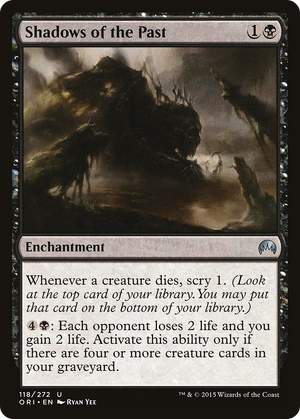
Shadows of the Past


The scry is the half people remember, but the drain is the design intent. Cheap black enchantments that filter on every creature death are common enough as incremental selection engines; the activated ability is what gives this card a clock and a payoff worth grinding toward. The gate (a stocked graveyard, four dead creatures deep) is the cost that earns the repeatable  swing: it asks the board to have already broken down, rewards a deck built to feed the yard rather than protect a single threat, and turns a passive selection engine into reach that can close games from outside combat. In a duel, each activation moves four points of life across the table (two off your opponent, two onto your total), and you can keep firing it as long as the yard stays full. The two halves reinforce each other in sequence: the death triggers that fill the graveyard are the same ones smoothing your draws toward the lands and threats keeping bodies on the table, so by the time the gate opens you have usually already dug toward whatever finishes the game. It is an aristocrats engine compressed onto a single enchantment, scry handling the bookkeeping and the drain doing the killing, sitting in the lineage of sacrifice-fueled black value pieces that treat creatures as a resource to spend rather than an army to hold.
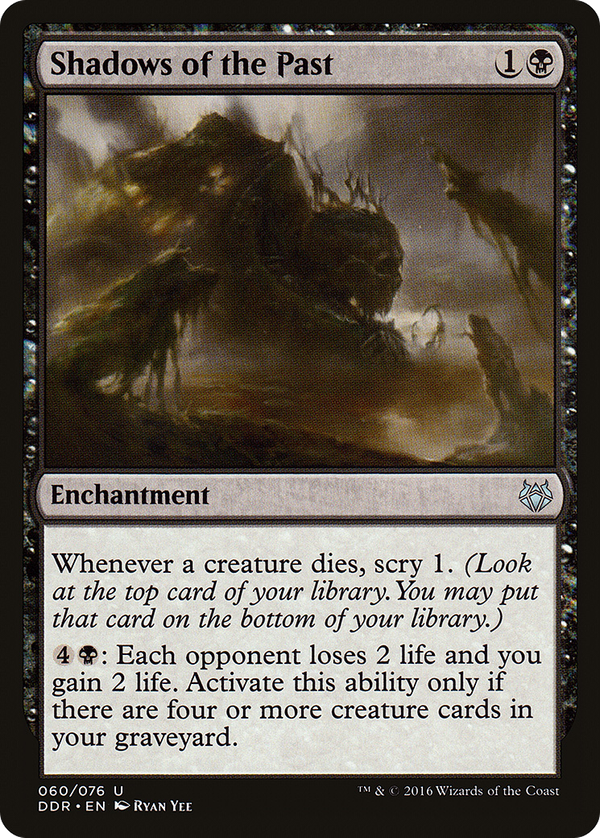
Rules text
: Each opponent loses 2 life and you gain 2 life. Activate only if there are four or more creature cards in your graveyard.