Serpent's Pass
Dual-color taplands that convert to a card once the game runs long are a familiar safety valve in the manabase toolkit: they fix two colors early, then cash out for a fresh draw when the fixing stops mattering. This one covers Dimir, taking its tempo tax up front by entering tapped for the right to produce blue or black, a cost you pay once and forget. The sacrifice clause is where the real design lives. At four mana plus the tap it is deliberately expensive, priced so the card-draw is a late-game floodgate rather than something you cash in the moment you draw a redundant land. That steep cost keeps the land honest: it never wants to be sacrificed on curve, so it earns its slot as a mana source first and a draw second, converting only when the board no longer needs the color it was providing. The idea is old, shared with the sacrifice-for-cardflow lands and the creature-lands that die into cards, all built on the premise that a manabase slot should stop being dead weight once the deck has enough mana. What this printing sharpens is the timing discipline: the tapped entry and the four-mana price both push the same direction, toward a land that pulls its weight early as fixing and then, well past the point of flood, quietly turns itself into the card the deck actually needed.
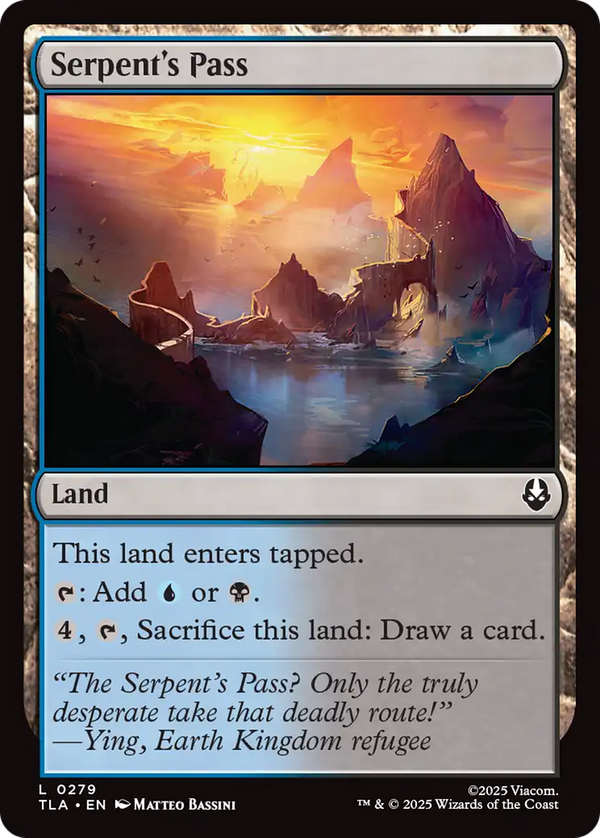
Rules text
 : Add
: Add  or
or  .
.
 , , Sacrifice this land: Draw a card.