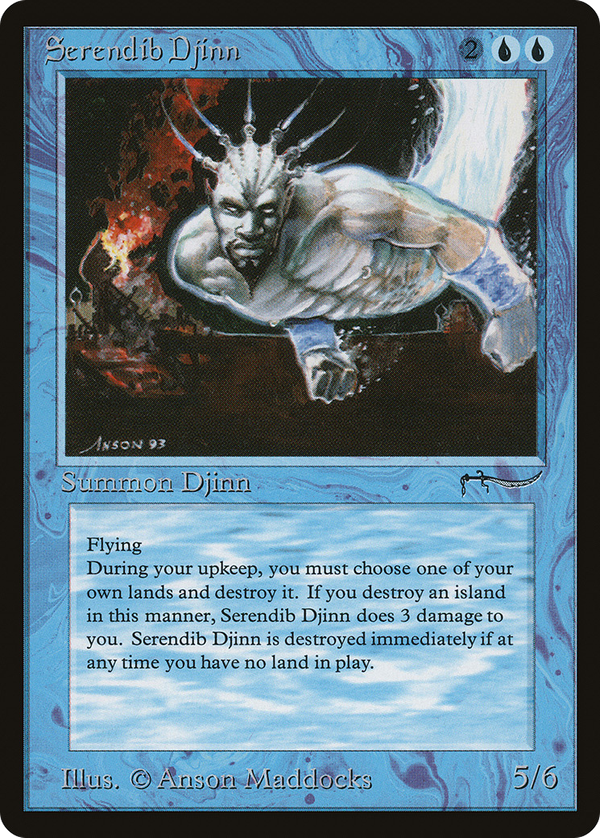
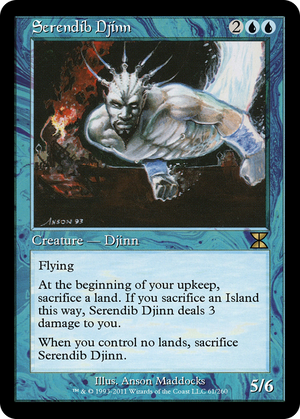
Serendib Djinn


Few early cards expose the design team's pricing anxiety as openly as this one. A 5/6 flyer for four mana was, and remains, a rate the game has almost never offered without a kill switch attached, and the kill switch here is the rarest kind: the card eats your own manabase, and punishes you specifically for running the color that casts it. The upkeep sacrifice is not a drawback in the modern sense (a life payment, a discard, a tap); it is structural decay, a clock pointed at the controller that runs alongside the clock pointed at the opponent. Play an Island to keep casting spells and take three; play a non-Island to dodge the damage and watch your color base evaporate. Run out of lands entirely and the Djinn sacrifices itself, closing the loop. The design logic is the proto-version of a question Magic has asked in many forms since (Phyrexian Negator, Lord of the Pit, the suspend drawbacks, the cumulative upkeep cycle): how much stat line can you sell for a self-inflicted countdown? The answer this card lands on (every-turn land sacrifice, color-specific damage, automatic self-removal) reads now as three separate drawbacks stapled together, because the era had no internalized sense of how much a single drawback should be worth. It is a fossil of the moment before Magic learned to price its own restrictions.