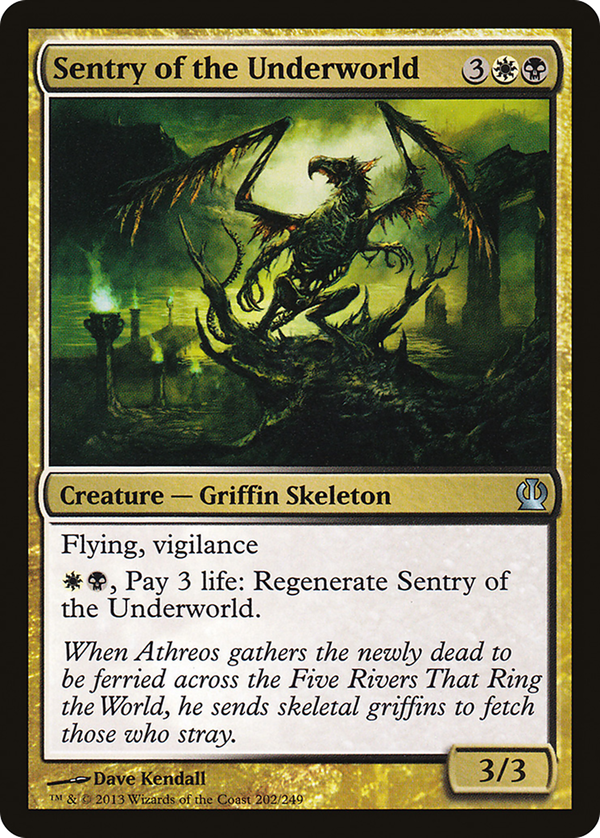
Sentry of the Underworld



Defense that never sleeps and never goes away: the body packs flying and vigilance, so it both patrols the ground and trades through the air without lowering its guard, while the regeneration tax turns it into a recurring roadblock against single-target removal and bad combat math. The Griffin Skeleton type line tells the story of how it was built: a griffin's mobility welded onto a skeleton's refusal to die. Skeleton regeneration is one of the oldest design tics in the game, usually priced cheaply because the bodies are small and grounded. Stapling that survivability to a 3/3 flier with vigilance is the wrinkle, and the cost rebalances accordingly: regeneration here is paid not in mana alone but in three life every time, so an opponent can race the activation even when they cannot kill the creature outright. That life clause is what keeps a value-attacker-and-blocker from running away with the game; each regeneration narrows your own clock against aggression. The result is a defensive piece that wants a slow, attritional game where flying and vigilance let it govern both halves of the board, and where paying life is an acceptable rent rather than a death sentence.
Rules text
, Pay 3 life: Regenerate this creature.