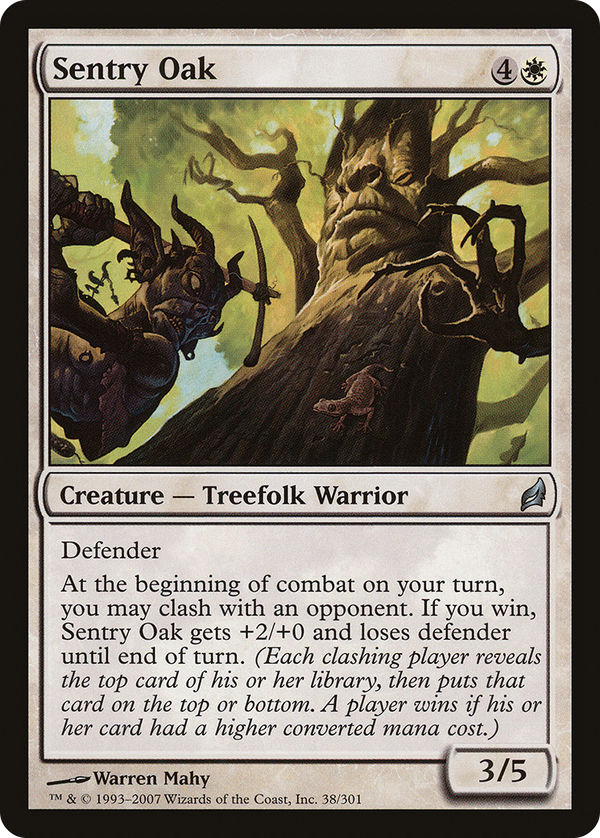
Sentry Oak


A 3/5 with defender holds a line as well as any wall, but the combat trigger turns each of your attack steps into a small contest: clash with an opponent, compare the mana values you reveal, and if yours is the larger the defender clause falls away and the power climbs, sending a 5/5 across for the turn. The design is doing two things worth watching. First, it treats defender as a conditional state rather than a permanent one, an experiment with letting a wall shed its keyword under the right reveal. Second, it hands you a lever over an otherwise random mechanic: clash rewards the steeper curve, and since you decide what fills your library, a deck weighted toward higher costs tilts the odds without ever guaranteeing them. The bonus fades at end of turn, though, so the card never settles into a dependable beater; it stays a wall that pokes back at intervals, the size of each poke decided by a peek you can influence but not promise. That intermittent aggression is the whole pitch: a creature whose defensive default is the floor and whose attacks are upside you build toward by weighting your curve upward.