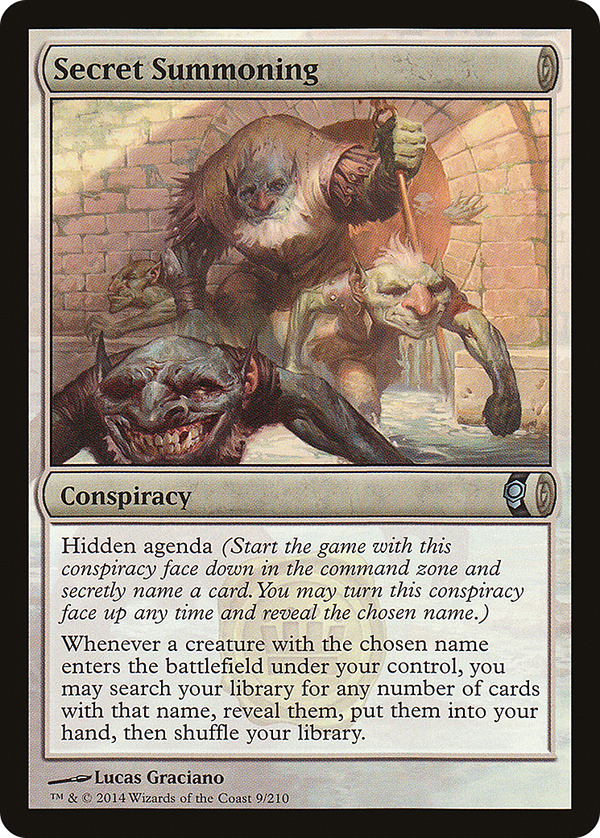
Secret Summoning
Hidden-agenda conspiracies live entirely in the metagame between players: a card you set face down before the first draw, holding a secret name nobody can play around until you choose to reveal it. This one weaponizes redundancy. Pick a creature that you run as a playset, and the first copy to land lets you rake the rest out of your library and into your hand at once, all for a name you committed to before anyone shuffled. The information asymmetry is the whole engine. Because the chosen name stays hidden, opponents cannot tell whether you have stacked your deck around a bomb worth tutoring four-deep or whether the conspiracy is a bluff sitting inert. The timing is the trap that pays for the free, repeatable tutoring: the trigger only exists if the conspiracy is already face up when the creature enters, so you must flip it while the creature spell is on the stack, not after it resolves. Reveal too late and the trigger never happens; reveal too early and you have warned the table what you are building toward. That window, narrow and one-directional, is where the skill lives. Conspiracies of this kind sit outside the normal rules of card advantage entirely, paying no mana and starting the game in a zone no ordinary card ever touches. The cost is commitment: you name the card before you know the board, and a misread leaves a dead secret you can never recoup.