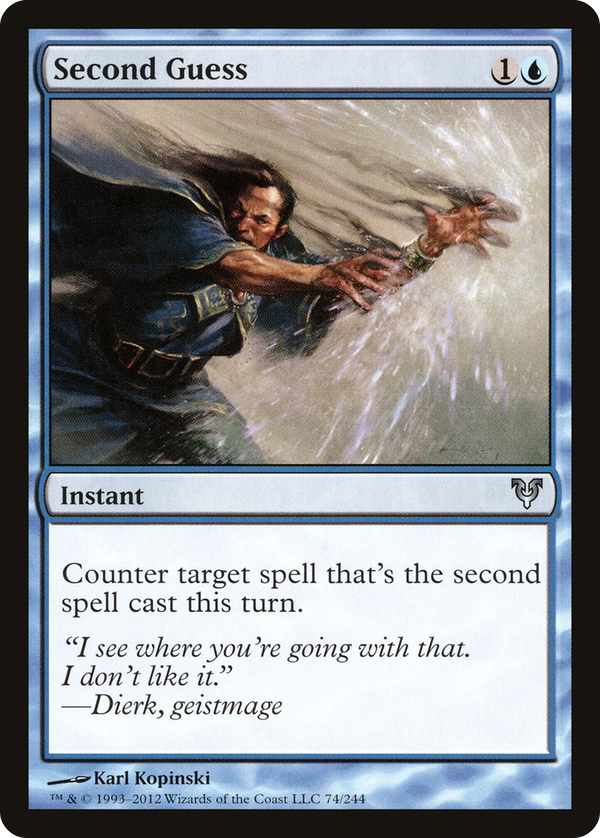
Second Guess


Most counterspells key on a property of the spell in front of them: a color, a mana value, a card type. This one keys on sequencing. It hard-counters whatever happens to be the second spell of the turn, no matter what that spell is, which turns the whole evaluation away from raw efficiency and toward reading an opponent's turn structure. Against a deck dumping its hand, the condition is trivially satisfied, and the second spell is often the one that matters: the follow-up to a bait play, the combo piece chained behind a cantrip. Against a cautious opponent content to make one play and pass, the card sits dead, waiting for a window that never opens. The design idea is a behavioral condition standing in for a static one. Where cheaper counters buy their discount with a tax, a partial effect, or a color restriction, this one buys it with a demand on the caster: predict when the second spell is coming. Meet that condition and the price buys a full, unconditional counter with no strings on what it hits. Miss the read and you are holding a card you cannot legally cast. It is a rare instance of a counterspell priced by the player's timing literacy rather than by anything printed on the target, and it rewards the caster who can see one beat further into the opponent's turn than the opponent expects.