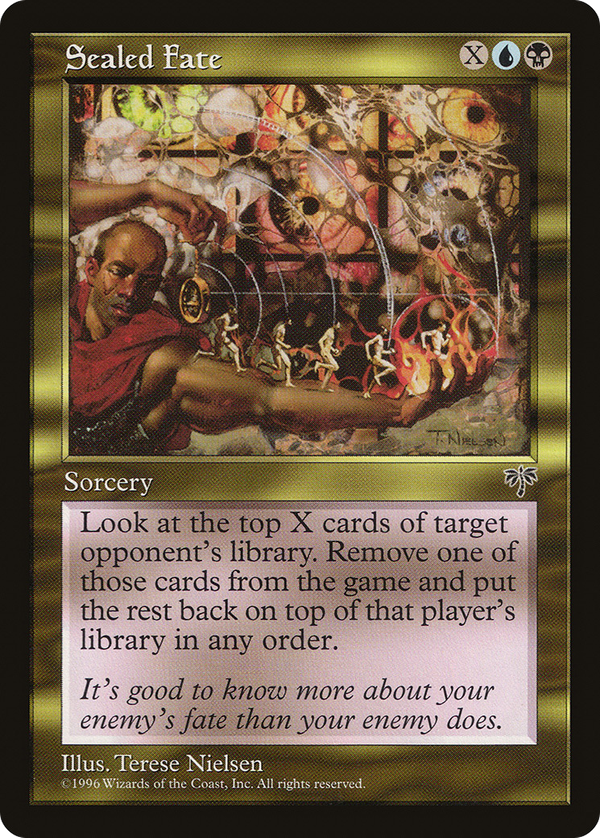
Sealed Fate



Blue's library manipulation almost always serves the caster: you scry your own top cards, draw, rearrange your own future. This turns the same motion outward, reading X cards off an opponent's deck and pulling one of them out of the game while you stack the rest back in whatever order suits you. The scaling X is the design discipline. At a small X it is cheap targeted disruption, a way to snipe a known threat off the top before it can be drawn; at a large X it digs deep enough to turn the whole upper portion of a deck into a menu, with the worst remaining card now guaranteed to be the next draw. The cost of that flexibility is information asymmetry working against you: you can only exile what you can see, so it answers what the opponent has drawn toward, not what is buried beneath. It belongs to the era when blue-black control disrupted an opponent's draws rather than countering their plays, a sorcery-speed proactive interaction that asks you to spend a turn dismantling someone else's plan instead of advancing your own. The reordering clause is the quiet upside that survives every game state: even when nothing on top is worth exiling, you still leave the opponent's next several draws arranged to your liking.