Scrying Glass

The design is a guessing game dressed as card advantage: you name a number and a color, the opponent reveals, and you draw only if your guess was exact. That "exactly the chosen number" clause is the whole joke. It is not a card that rewards information; it punishes you for not already having it. Predict three white cards when they hold two, or four, and you get nothing for your three mana and a tap. Urza's Destiny was a block built around busted card-advantage engines, and this one sits at the opposite pole: a repeatable peek bolted to a payoff so conditional that the peek itself becomes the only reliable function. You can tap it every turn to watch the opponent's hand, which is genuine information, but the draw it dangles is a lottery ticket priced like a real spell. The intuition it gambles on is that you can read a hand well enough to call its composition by color and count, the way a poker player calls a board. In practice the variance swamps the read: hands shift every draw step, and a single off-by-one means the activation produced nothing but a free look. It survives as a curiosity from an era when Wizards was still experiment-pricing repeatable card draw, willing to staple a real payoff to a near-impossible condition and let players discover the math the hard way.
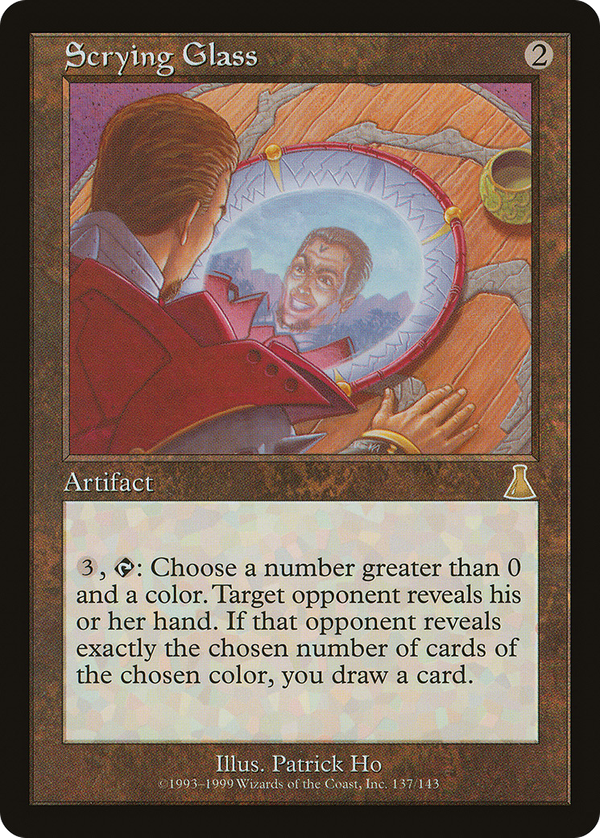
Rules text
 ,
,  : Choose a number greater than 0 and a color. Target opponent reveals their hand. If that opponent reveals exactly the chosen number of cards of the chosen color, you draw a card.