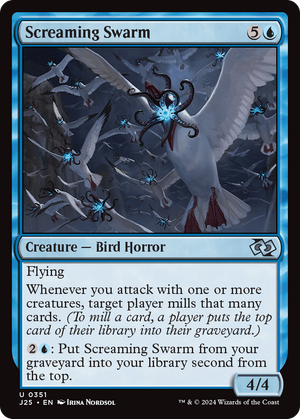
Screaming Swarm


Mill has always fought the same structural problem: it is a win condition that does nothing to the board, so the deck spends its early turns counting cards on a clock while the opponent develops threats it can ignore. This design answers that tension by welding the mill onto an attack trigger. Every creature you send in adds to the count, which means the flying body is not a distraction from the mill plan but the engine that scales it: a wide board and a decking board become the same board. The recursion clause is the more inventive piece of construction. Rather than returning to hand or the battlefield, the card slides itself into your own library second from the top, so a strategy that grinds over many turns keeps its primary payoff out of range of an opponent's spot removal. That refusal to die cleanly matters, but the clause is honestly costed: three mana buys you the card back at the price of your next natural draw, since it becomes the card you pull one turn later rather than a fresh one. The loop reloads a threat without accelerating your own game, which is exactly the restraint a recursion engine on a six-mana body needs. What emerges is a mill payoff that wants to be a creature deck first, an unusual inversion for an archetype more often assembled from enchantments and sorceries that ignore combat entirely.
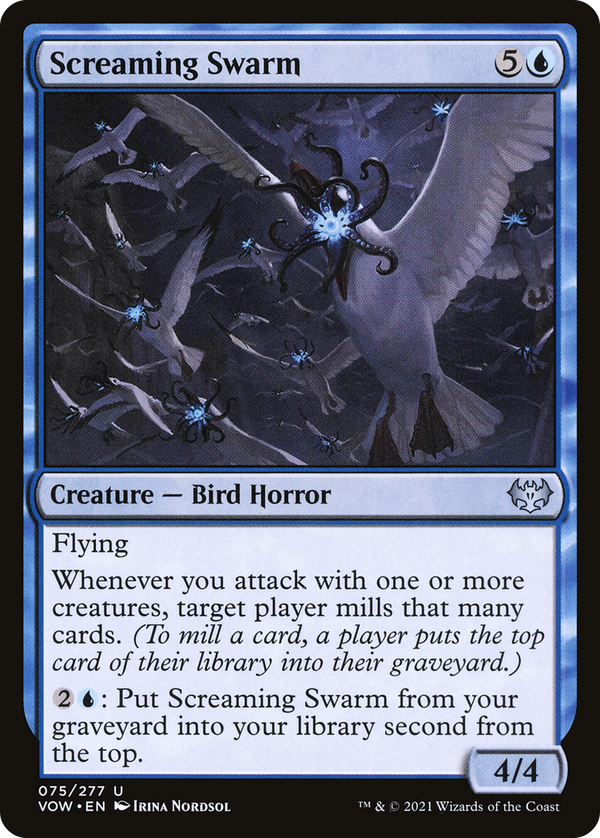
Rules text
 : Put this card from your graveyard into your library second from the top.