Scour


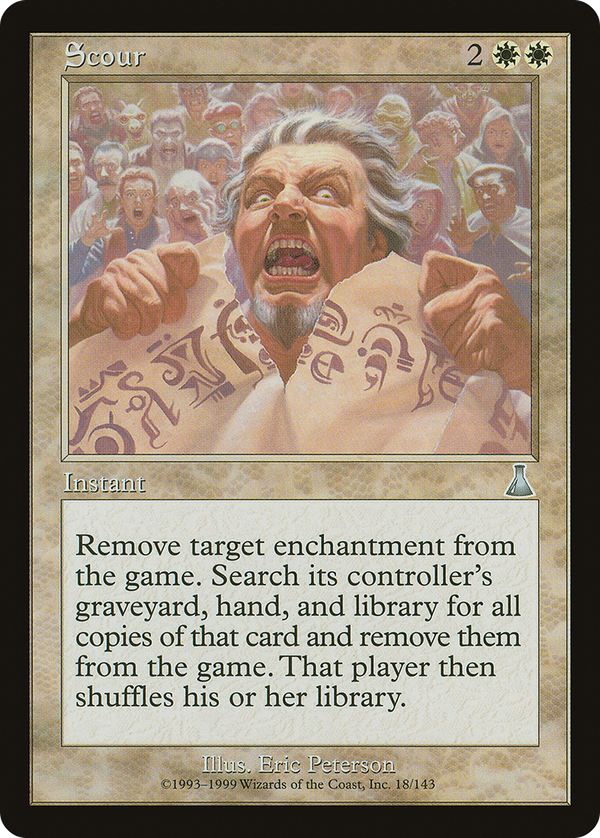
The interesting design move here is not the exile, which white had been doing to enchantments for years, but the deck-search clause that strips every copy of the named enchantment from the controller's graveyard, hand, and library all at once. This is the four-of answer to the four-of problem: where a normal Disenchant trades one-for-one with a single permanent, this trades one-for-many against a deck leaning on multiples of the same enchantment, then forces the shuffle so even the topdeck off a freshly randomized library is uncertain. The cost of that reach is the strict targeting: it needs an enchantment already on the battlefield to point at, so it does nothing against a player who has not committed a copy yet, and it can only ever name what is in front of you. That gives it a feast-or-famine profile, dead in matchups where nobody runs redundant enchantments and brutally lopsided in the ones built around an enchantment engine. It is one of the early name-stripping effects that read like surgery on a deckbuilding pattern rather than removal aimed at a single threat. The instant speed matters mostly for tempo: you can hold it as an open answer and resolve it the moment the controller commits a copy to the board, rather than tipping your hand at sorcery speed.