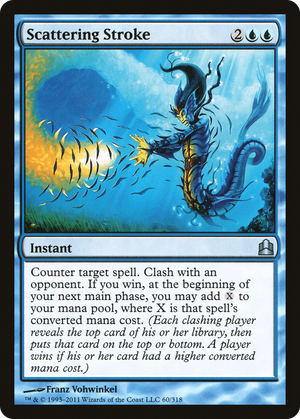
Scattering Stroke


Counterspell wearing a lottery ticket. The base mode is the genre standard: four mana to stop anything, no restriction on target, no friction beyond the price. What the design grafts on is a clash payoff that turns the negated spell's size into your reward, which inverts the usual cost of countering an expensive threat. Counter their seven-drop, win the clash, and you bank seven colorless toward your next play; the bigger the thing you stopped, the bigger the rebate. The catch is that clash is a coin flip you only partly control, and it resolves with a delay: the mana does not appear when you counter, it waits until the beginning of your next main phase, by which point you have already spent your turn's window deciding whether the gamble was worth building around. The card distills the clash mechanic's whole pitch, which was to bolt a variance-driven upside onto otherwise fair effects so that library manipulation and top-of-deck control had a reason to matter. As a counterspell, the floor is honest and the ceiling is conditional: you are paying full rate for the guaranteed half and treating the mana as found money. That structure (a reliable effect with a stochastic kicker) is the thing worth studying here, more than the rate itself.
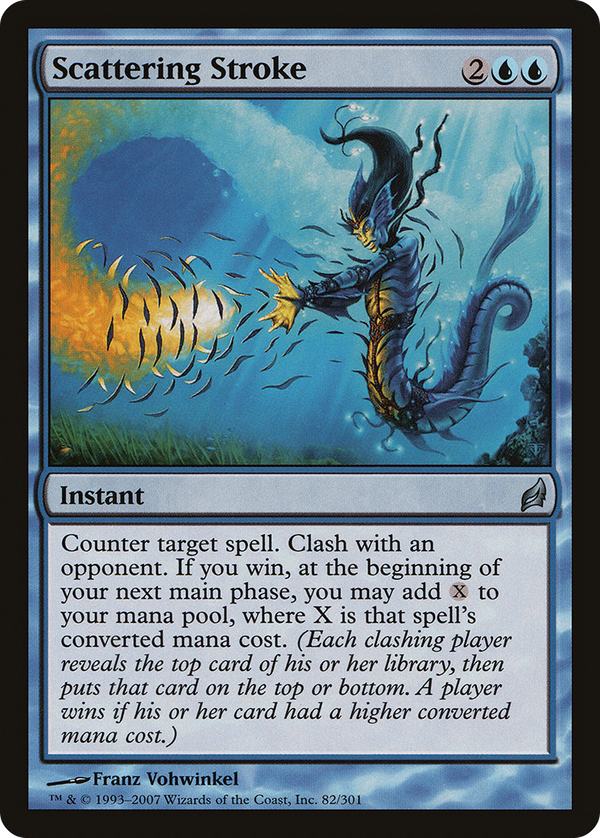
Rules text
 equal to that spell's mana value. (Each clashing player reveals the top card of their library, then puts that card on their choice of the top or bottom. A player wins if their card had a greater mana value.)