Scarwood Hag


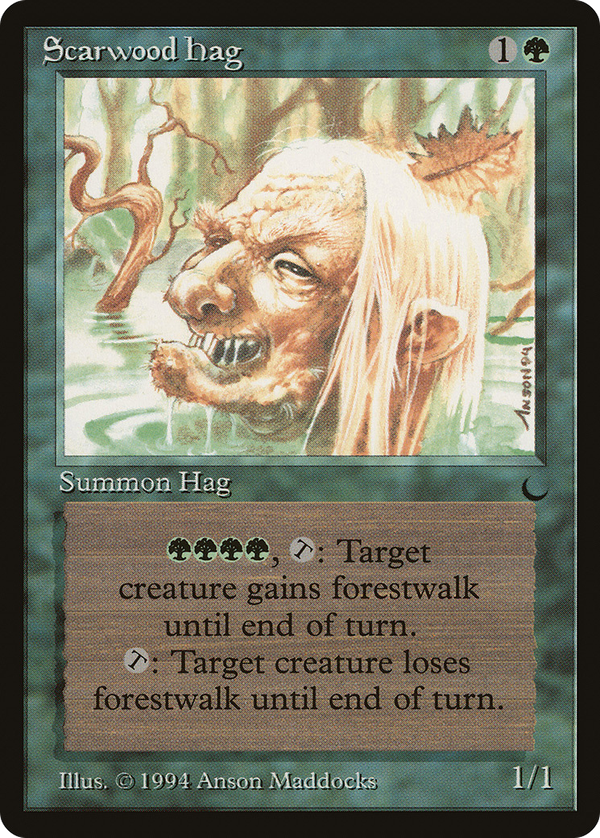
A perfect artifact of mid-nineties design economics, where evasion was scarce enough that an entire card could be built around granting and revoking a single landwalk type. The activation cost tells the whole story: four green mana plus a tap to hand out forestwalk, a punishingly steep rate for an ability that does nothing against an opponent who controls no Forests. The second mode, stripping forestwalk for a tap, exists to undo what some other green creature granted, a defensive answer to a problem the card itself is half-responsible for creating. This is landwalk as a self-contained arms race rather than as a real evasion plan. The body is a 1/1 with no protection, so the hag survives only as long as the opponent declines to spend any removal on it, and the four-mana activation means the turn you commit to making something unblockable is a turn you are doing little else. What makes the design instructive is how clearly it shows the era's assumptions: that punishing an opponent for the basics they happened to run was a legitimate axis of attack, that abilities priced in quadruple-pip costs were acceptable on a fragile common-grade body, and that a creature could earn a slot purely by gating one keyword. Nothing about the rate survives the move to faster formats, but as a snapshot of how landwalk was understood before evasion got cheap and reliable, it reads like a museum label.
Rules text
,  : Target creature gains forestwalk until end of turn. (It can't be blocked as long as defending player controls a Forest.)
: Target creature loses forestwalk until end of turn.
: Target creature gains forestwalk until end of turn. (It can't be blocked as long as defending player controls a Forest.)
: Target creature loses forestwalk until end of turn.