Scale of Chiss-Goria

The runt of the original affinity artifact spread, and the clearest illustration of why the mechanic's small cards were never the problem. Affinity made it free in the decks that wanted it, but free is a meaningless discount when the payoff is a tap to give one creature a single point of toughness. The flash matters more than the pump: it lets the card slide onto the battlefield during combat or at end of turn, and in a deck overflowing with cheap artifacts, dropping it for zero to nudge affinity counts on the rest of your hand was a more honest use than the actual ability. That gap between cost and effect is the whole lesson. The designers built affinity to make artifact-dense decks cast their spells for nothing, then printed enough artifacts to populate those decks, and some of that population had to be filler that existed to be counted rather than cast. This is filler that was counted: a colorless artifact whose best contribution to a board was lowering the number on everything else. It sits in a spread of cheap stat-tweaking artifacts that reads as an attempt to give artifact decks a toughness-granting blocker enabler, but the affinity environment cared about quantity, not the body's function. A card built to do a small job inside a mechanic that rewarded you for not needing it to do anything at all.
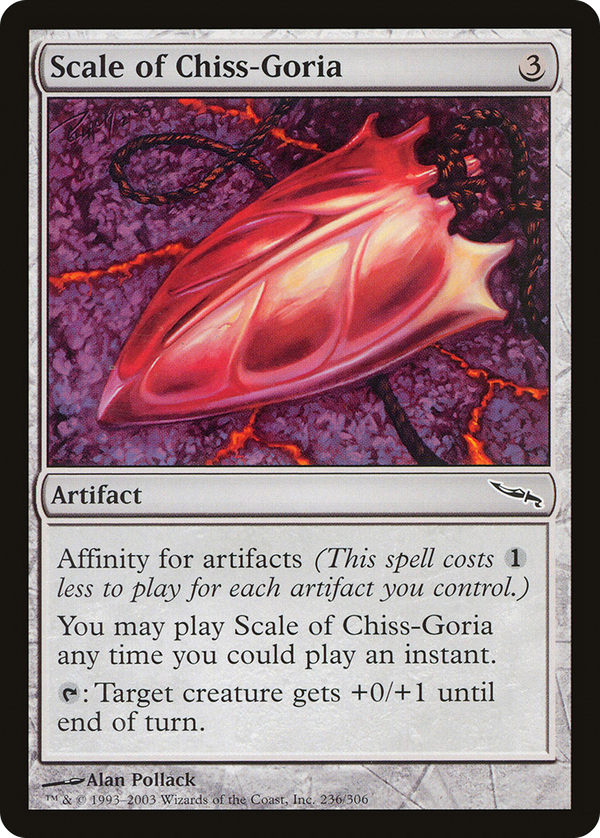
Rules text
 less to cast for each artifact you control.)
 : Target creature gets +0/+1 until end of turn.