Savai Crystal

Three-color mana rocks share a single failure state: draw one after the board is built and it taps for a color you no longer need, a topdeck that trades a card slot for redundant fixing. The cycling clause answers that state head-on. Early, it fixes a Mardu manabase and produces one mana of red, white, or black the turn it lands; late, when another mana source is the last thing you want, you pay two and swap it for a fresh card. Every triad in this cycle got its own version, each tapping for its three colors with the same cycling cost, so no single copy is dead weight regardless of when it shows up. The tradeoff is plain and unhidden: three mana for a rock that only fixes, with no ramp beyond the extra source, no bonus utility, and no cost reduction. It gives one mana of any of its three colors rather than the burst a splashier artifact might muster. What that buys is a slot that stays live from turn three to turn fifteen: it fixes when fixing matters and becomes a card when it does not, which is precisely the anxiety longer games load onto mana rocks in the first place.
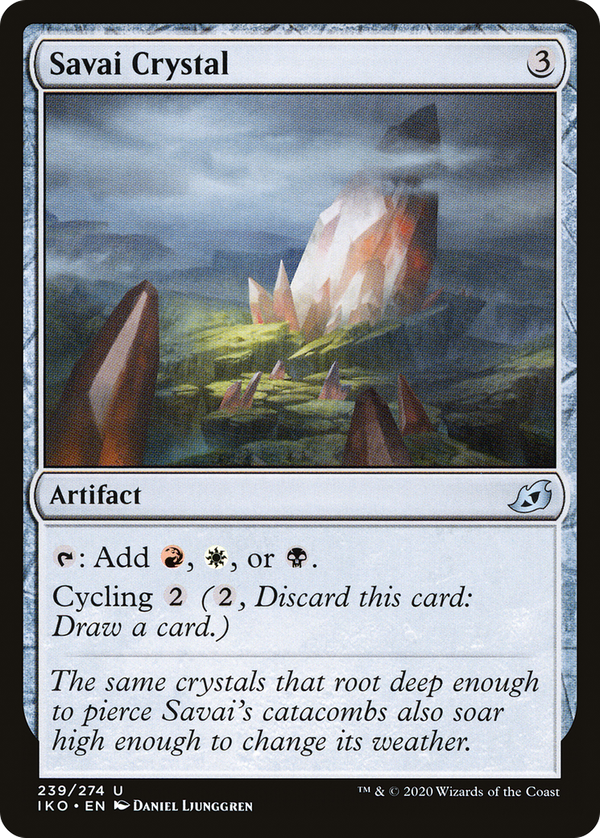
Rules text
 : Add
: Add  ,
,  , or
, or  .
Cycling
.
Cycling  (, Discard this card: Draw a card.)