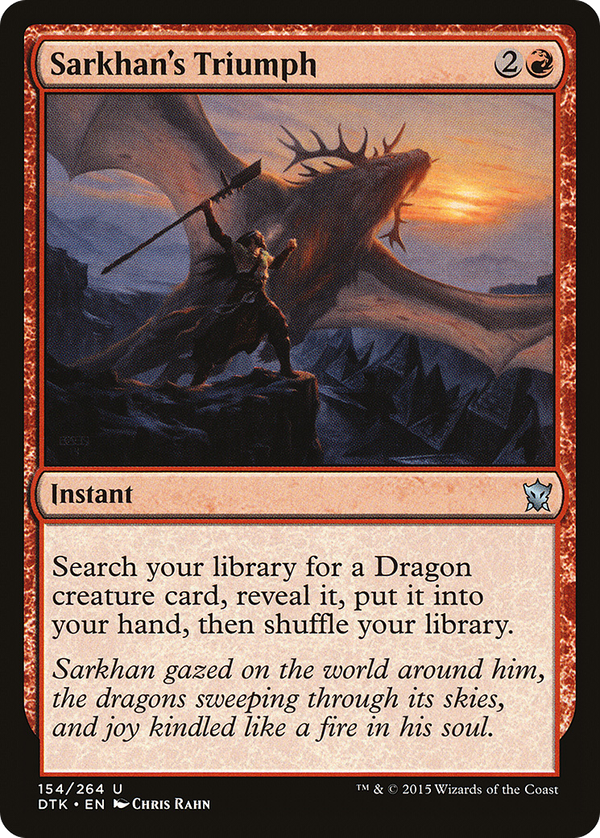
Sarkhan's Triumph


A tutor priced to the body it fetches, not the search itself. Three mana to find a Dragon and put it in hand is a steep rate for what is mechanically a card-selection effect: you pay a creature spell's worth of mana to draw a specific creature you still have to cast separately. The design logic is that the targets justify the toll. In a deck where every Dragon is a haymaker, the consistency of finding the right one matters more than the tempo cost, and the instant-speed window lets you hold the search until the board has revealed what it wants. That timing is the quiet part doing the work: fired off during the opponent's turn, the search banks the information advantage of watching their line play out before you commit, then hands you the Dragon to deploy on a clean, untapped turn of your own. Tribal tutors of this shape (a search locked to one creature type, paid for at a surcharge over an open-ended Worldly Tutor that finds anything for a single mana) live or die by the depth of the type pool, and Dragons are among the deepest in the game: enough top-end variety that the search almost always has a relevant answer, whether that is a finisher, a removal-dragon, or a value engine. It does nothing without a Dragon base to point at, but in that base it converts raw mana into reliability.