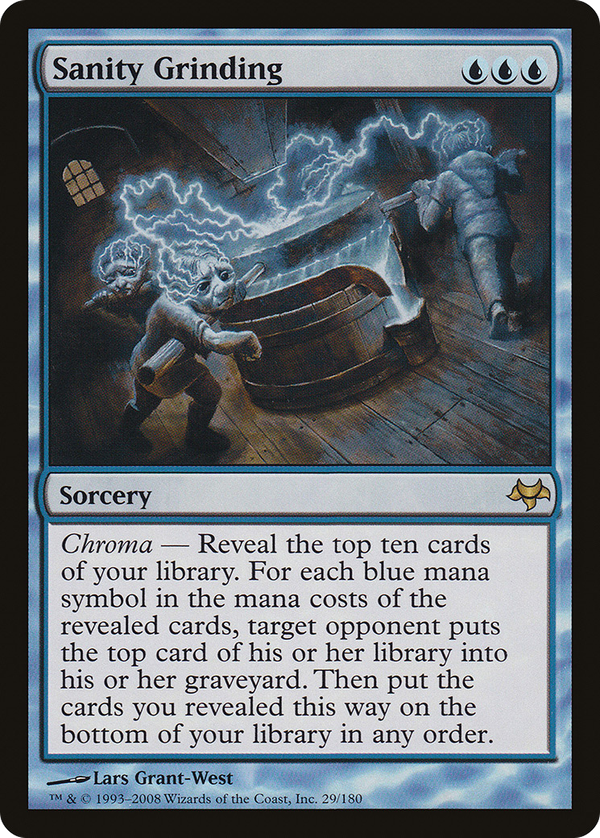
Sanity Grinding

The triple-blue cost in the corner is the design tell: this mill spell pays you back for leaning blue and pays little if you do not. Chroma counts pips in your own library rather than reading the board, which makes the math recursive in a way most variance engines avoid: the deeper your commitment to blue, the larger the expected mill, and a deck splashing a second color is quietly halving its own payoff. The arithmetic compounds because it counts every blue symbol across all ten revealed cards, not the cards themselves. Reveal a fistful of double- and triple-blue spells and a single cast can dump fifteen, twenty, sometimes more cards off an opponent's library; in a deck built to maximize blue density, the ceiling is closer to a finisher than to a tempo trade. The honesty lives in the floor: a top ten thick with lands or nonblue noise, and your three blue mana buys a card or two of mill, maybe none. The revealed ten go to the bottom of your library in whatever order you choose, so they are not exiled or spent, but the spell itself and three blue mana are gone regardless, and the reorder still rewrites where your own draws will land. So the card runs hot and cold, a high-ceiling payload whose downside is real, and it asks the deck to have already decided to be aggressively, unapologetically blue, which is the kind of all-in commitment mill as a win condition demands anyway.