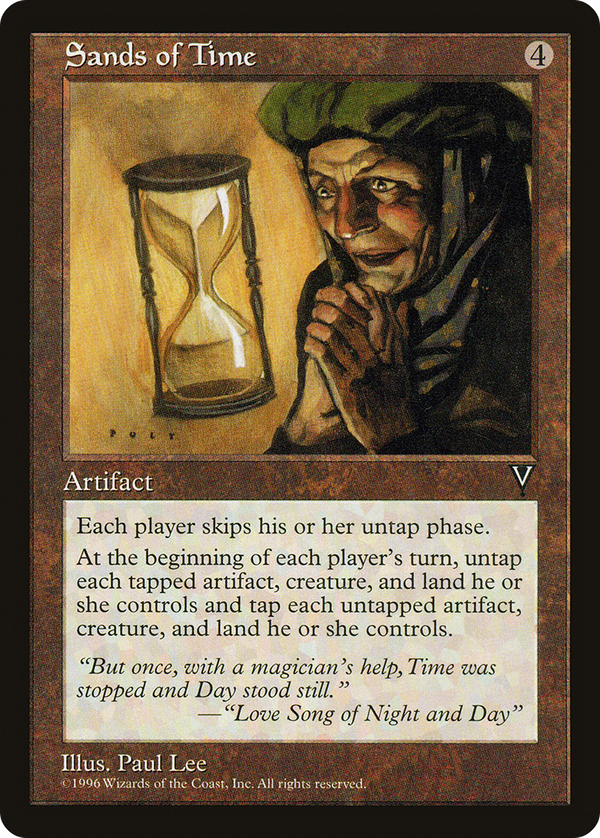
Sands of Time

A symmetry puzzle dressed up as a global enchantment effect. The core inversion is that it does not stop permanents from doing their work; it permanently swaps the relationship between tapped and untapped. Instead of untapping in your untap step, every artifact, creature, and land you control flips state at upkeep: what was tapped comes up, what was up goes down. The consequence runs deep. Lands that produced mana last turn are untapped again on your upkeep, but anything you cast and leave open promptly taps itself at the next flip. Creatures live in a stutter-step: a creature you leave home is untapped during your turn and ready to block; one that attacks becomes tapped and stays tapped through the opponent's turn, so it cannot block until it flips back up on your upkeep. That asymmetry is where the design lives. Because the flip happens on each player's own upkeep, the symmetry is not actually symmetric: whoever sequences their plays around the swap controls more of their board state than the opponent does. It rewards permanents that want to be tapped (mana abilities that pay off on activation, anything whose value comes from spending tap state rather than holding it open) and punishes a board that only functions untapped. The trap is reading it as a Stasis-style lock; it is closer to a metronome you can phase to your own beat if your deck is built to alternate. Few cards from its era treat tap state as a resource you spend forward in time rather than a default you reset to.