Sands of Delirium

The activation has no built-in ceiling, which is both the appeal and the trap: untap, pour your whole turn into the  cost, and a real chunk of a library lands in the graveyard on a single tap. But every point of that progress is taxed through mana, and a colorless artifact with no protection sitting on the battlefield as the entire game plan is a telegraphed wincon an opponent has all the time in the world to dismantle. Mill engines on a repeatable artifact body have always wrestled with the same arithmetic: a library is large, each activation chips at it, and a slow pinger has to either close before the opponent's clock connects or build inevitability the opponent cannot reverse. This sits on the grindy end of that spectrum, where the clock it offers is measured against incoming combat damage rather than racing it. The targeting clause is the quiet flexibility: it reads "target player," so the same activation can fuel your own graveyard in a deck that wants cards there rather than only attacking an opponent's deck, though that use was almost certainly incidental rather than intended. What it represents is the recurring artifact-mill design that surfaces across eras of the same idea: easy to deploy, theoretically unbounded, fragile to any removal, and almost always outpaced by an opponent actually trying to win, a rate that flatters the engine's ambition more than its body delivers.
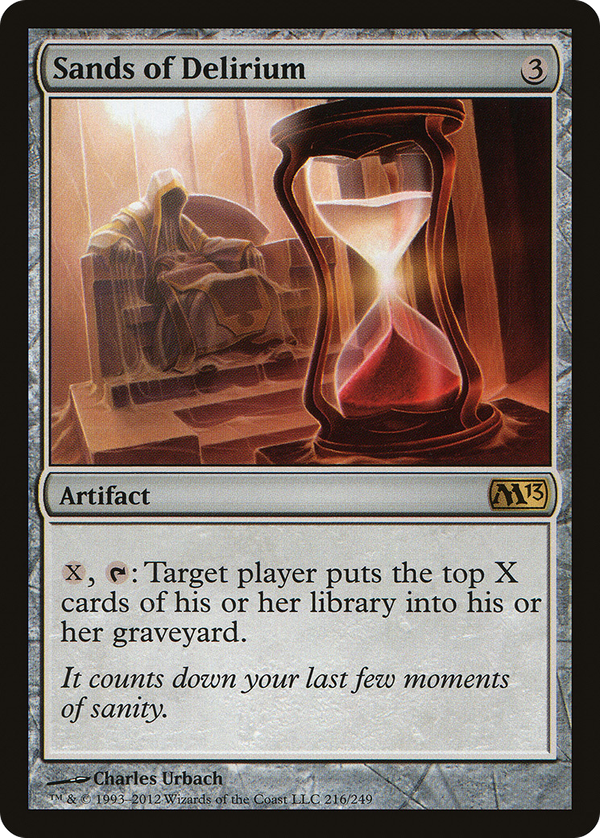
Rules text
,  : Target player mills X cards.