Salvaging Station

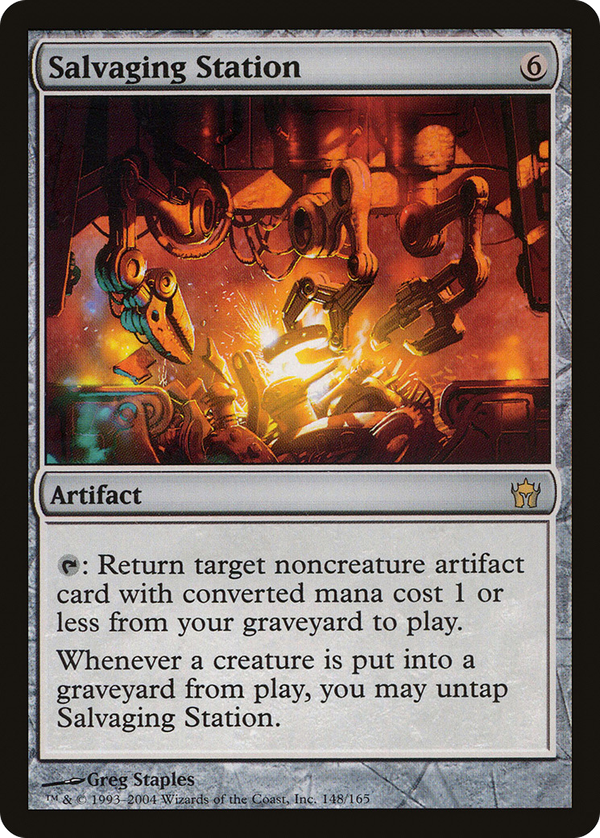
The death-trigger untap is the whole engine, but it only matters because the thing that dies and the thing that returns are deliberately different cards. The tap ability hauls back cheap noncreature artifacts; the untap fires off any creature death. So the loop never closes on the station alone. You need a recursion target that converts into a creature body and a creature that obligingly dies to feed the trigger, then the machine wants both halves cycling: return the artifact, sacrifice it for a creature or token, that death untaps the station, return the artifact again. Most repeatable graveyard recursion of this era was gated behind a single tap you got once per turn; this design launders its activation through the death trigger instead, so the ceiling becomes "how many creatures can you funnel into the graveyard" rather than "how many untap steps have I taken." That reframing is what turns it from a value engine into a combo piece: assemble enough free or near-free sacrifice fodder and a payoff that scales with iterations, and the activation count stops limiting anything. Left to itself, the six-mana body sits inert and demands a board state to exploit. The card's identity lives entirely in the gap between its narrow recursion clause and its broad untap condition, where someone clever bridges the two and converts a slow artifact into a counter they increment until they win.
Rules text
 : Return target noncreature artifact card with mana value 1 or less from your graveyard to the battlefield.
Whenever a creature dies, you may untap this artifact.
: Return target noncreature artifact card with mana value 1 or less from your graveyard to the battlefield.
Whenever a creature dies, you may untap this artifact.