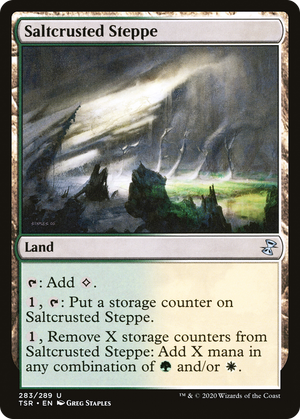
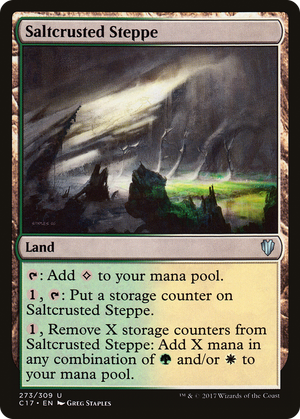
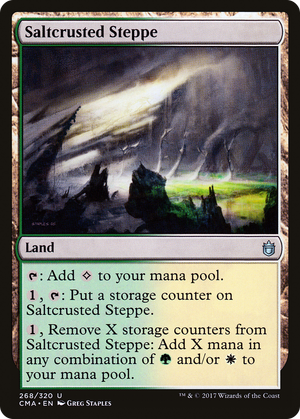
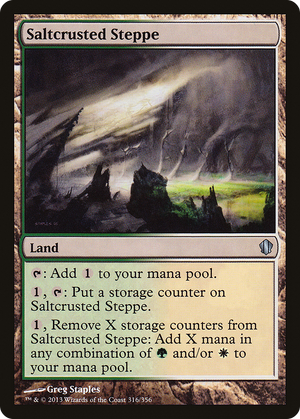
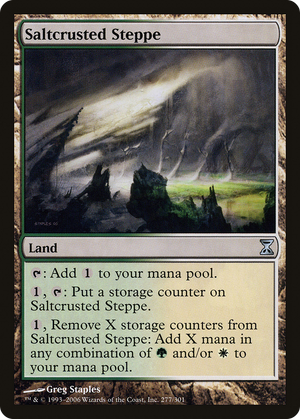
Saltcrusted Steppe
Mana banks like this one answer a problem most fixing lands ignore: the dead early turn. Instead of paying a tapland's entry fee up front, you pay over time, sinking surplus mana into storage counters across turns where the board has stalled, then cashing them out for a burst of green and white when the spell that demands it finally lands. Each counter costs a generic mana to bank and returns one colored mana to spend, so the land defers value rather than generating it; you are buying control over when your mana exists, not over how much of it you get. That makes it a slow-deck instrument by construction, rewarding games that grind long enough for stored counters to convert into a single explosive turn. The tension lives in the tap symbol: charging requires tapping the land, and so does drawing colorless from it, so every turn forces a choice between banking toward the payoff and spending now. That competition is the cost of the design, the reason you cannot both ramp the counters and lean on the land for mana in the same turn. It belongs to a set of storage lands that each hoarded a single guild's colors, and the Selesnya pairing fits exactly the patient, resource-stockpiling strategies that want a payoff worth charging toward rather than a curve to hit on schedule.
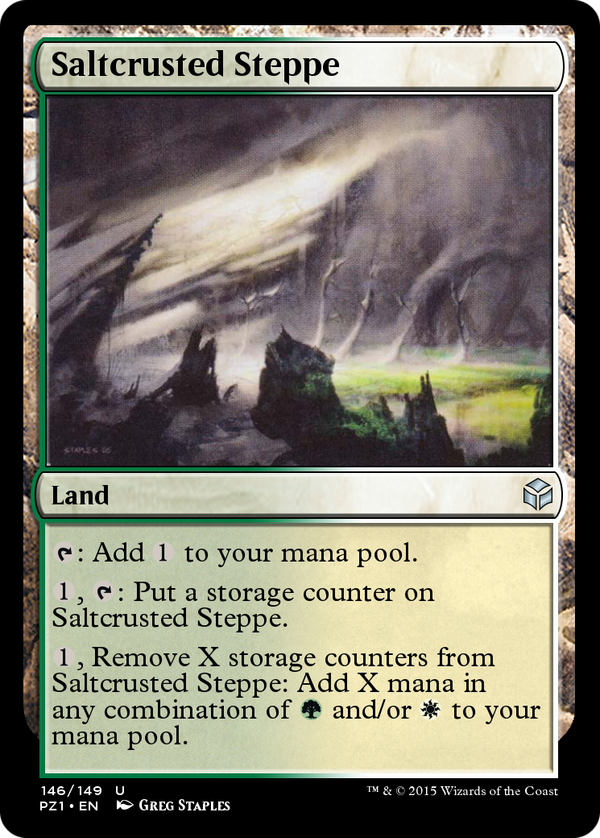
Rules text
 : Add
: Add  .
.
 , : Put a storage counter on this land.
, Remove X storage counters from this land: Add X mana in any combination of
, : Put a storage counter on this land.
, Remove X storage counters from this land: Add X mana in any combination of  and/or
  .
.