Salt Road Patrol


Outlast was the slow-roll mechanic built for the grindiest archetype in its block: tap down, do nothing on the turn you activate, and trade tempo for inevitability. A 2/5 wall is the body that justifies the bargain. The toughness lets it block early without dying, so the opportunity cost of tapping it to grow rather than attack is small; it was never going to swing on turn four anyway. Each activation costs  and turns the Scout into a steadily larger threat that also blocks better every turn, the rare case where the defensive stats and the counter-stacking plan reinforce each other instead of competing. The catch baked into the keyword is that outlast only works at sorcery speed, so the counters arrive on your own turn, telegraphed, with the creature tapped and unable to ambush anything. That timing restriction is what keeps a repeatable two-mana pump honest: you commit before you know what the opponent does, and you give up a blocker for a turn each time you reach for it. As a piece of mechanical design, outlast is white's answer to the question of how a defensive deck closes a game it has already stabilized, and this is the plainest expression of that idea: a brick wall that, given enough idle turns, eventually walks across the table.
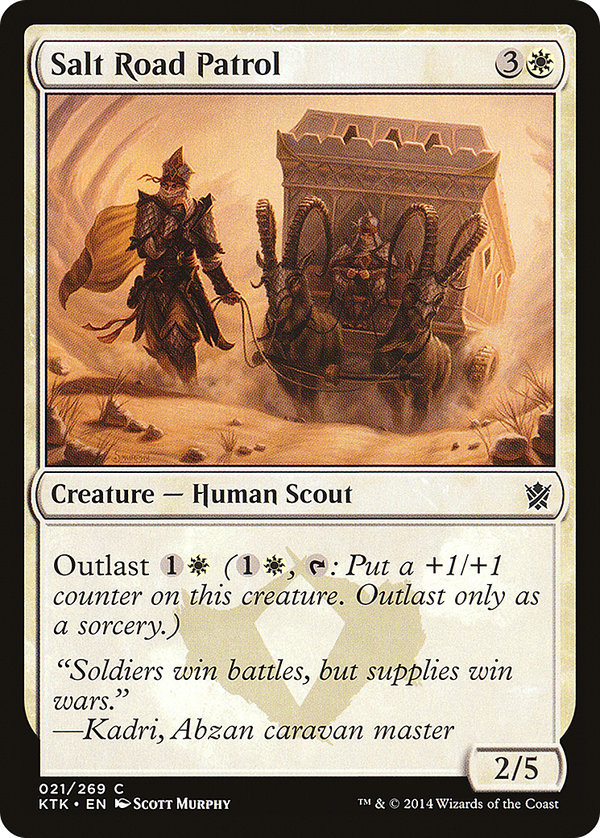
Rules text
(,  : Put a +1/+1 counter on this creature. Outlast only as a sorcery.)