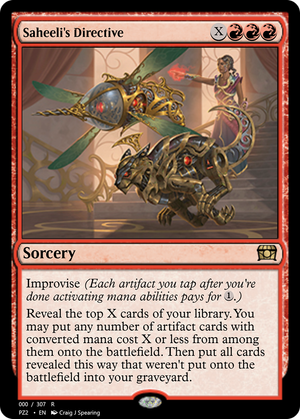
Saheeli's Directive


The single X here governs two things at once, and reading it as a single lever is the mistake that sinks the card. That X sets both how many cards you dig through and the mana value ceiling for what you can cheat onto the battlefield, so the two scale together: reveal seven and you may slam anything with mana value seven or less. The trouble is the graveyard tax underneath. Everything you turn up that you cannot or choose not to play gets milled, so a bigger X is not a free upgrade; it is a deeper dig that risks pitching the very artifacts sitting just above your reveal count or the ones you already needed elsewhere. Improvise is what keeps the cost from strangling the ambition: every artifact you tap toward the RRR-plus-X price buys another point of X without draining your mana, so a board already thick with rocks and cheap constructs can turn a modest hand into a sweeping dig. That interplay rewards a specific shape of deck, one dense enough in artifacts to fuel improvise and dense enough in high-impact ones to justify the self-mill. It reads like a lottery and plays like a calculation: you are pinning X to the exact number where your artifact curve, your available improvise fodder, and your tolerance for burying key pieces all meet. Miss low and the payoff stays hidden; miss high and half your library ends up in the yard; hit it and you build a battlefield in one sorcery.
Rules text
 .)
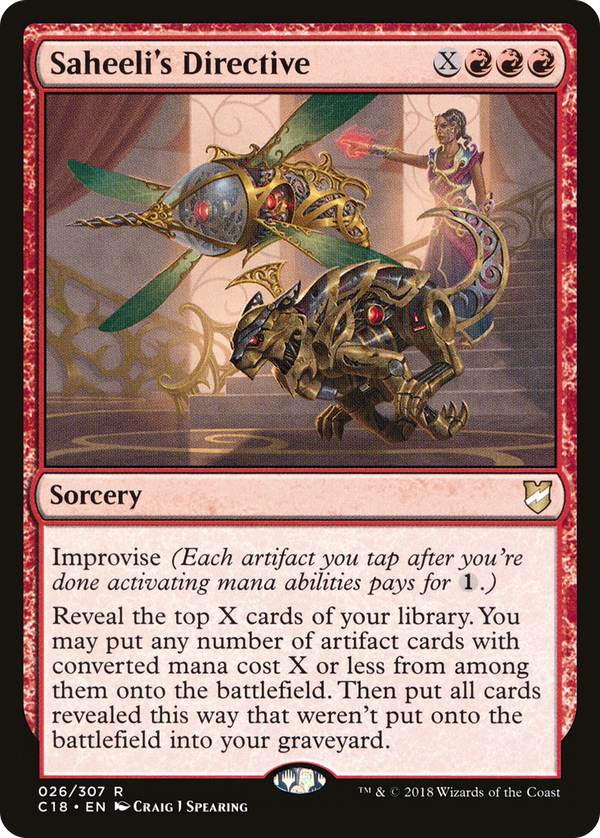
Reveal the top X cards of your library. You may put any number of artifact cards with mana value X or less from among them onto the battlefield. Then put all cards revealed this way that weren't put onto the battlefield into your graveyard.
.)
Reveal the top X cards of your library. You may put any number of artifact cards with mana value X or less from among them onto the battlefield. Then put all cards revealed this way that weren't put onto the battlefield into your graveyard.