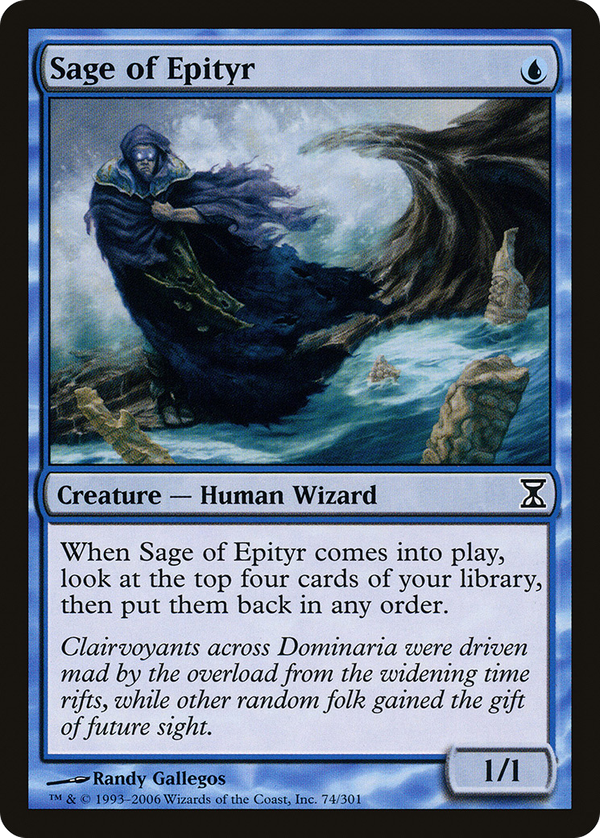
Sage of Epityr

Library manipulation without card advantage is a narrow design space, and this is one of its purer expressions: a body that arranges the top four cards and then leaves them there, drawing nothing. The value lives entirely in the reorder, which means the creature is only as good as the engine that cashes the new top of the library: a draw step that wants a specific card, a Brainstorm-style shuffle to bury what it surfaced, a fetch effect that pulls from the top, or a recursion loop that replays the enter trigger again and again. On its own it sets up one good draw and dies a 1/1. Bounced or blinked repeatedly, it becomes a slow but exact filtering machine, the kind of cog that wants to be flickered rather than cast once. That dependence is the whole tension: the look-and-reorder is information turned into ordering power, and ordering power is worthless until something downstream reads from the order. Early designs of this stripe tended to be appraised as build-around fodder rather than maindeck staples, and that judgment fits here. The Wizard tag and the cheap cost are the seams where it connects to a deck built around repeatable enter-the-battlefield triggers, not a reason to run it cold.