Rust Goliath

Ten generic mana buys a 10/10 with reach and trample, a body colorless enough that every deck could theoretically want it and expensive enough that most never will. The two costs printed on the card are the whole idea: fold the same construct down to a green 3/5 for 
 and you have swapped a top-end ramp payoff for an early wall that trades up against ground creatures and knocks fliers out of the sky. Both modes are the same object on the stack and the battlefield, so anything that fetches, cheats out, or otherwise cares about artifact creatures still sees it no matter which price you paid, and the keywords ride along without a second line of text. The reach-and-trample package is doing quiet work in both directions: it keeps the cheap green version a genuine defensive body rather than a placeholder, and it lets the colorless version bull through chump blockers instead of stalling on them. What the design solves is the perennial problem of the big generic construct, which can never be pushed for one deck without being pushed for all of them. Splitting the card into two identities lets the ramp deck have its finisher and a green deck have its curve-filler out of the same printing. The green half is the real statement: it hands colorless artifacts a way to live inside a color's early turns rather than waiting on the mana to go big.
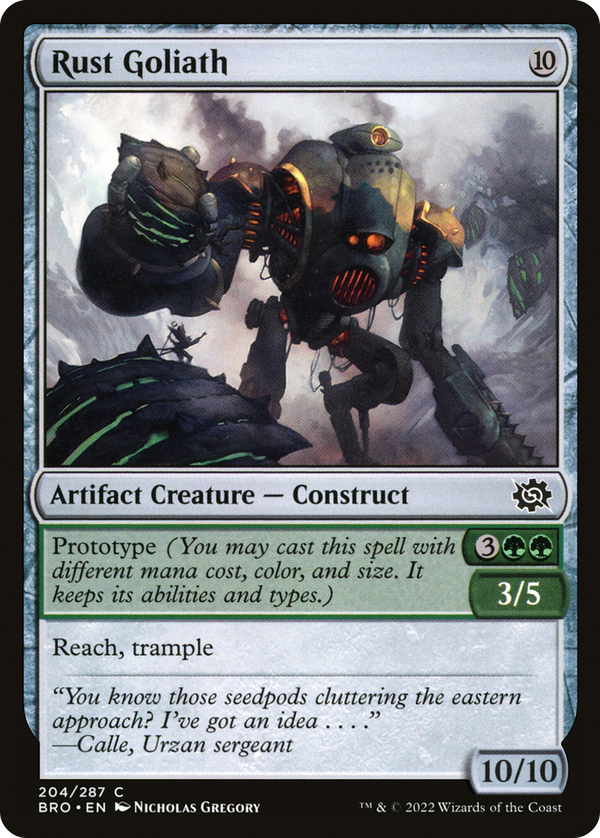
Rules text
— 3/5 (You may cast this spell with different mana cost, color, and size. It keeps its abilities and types.)
Reach, trample