Rushwood Herbalist


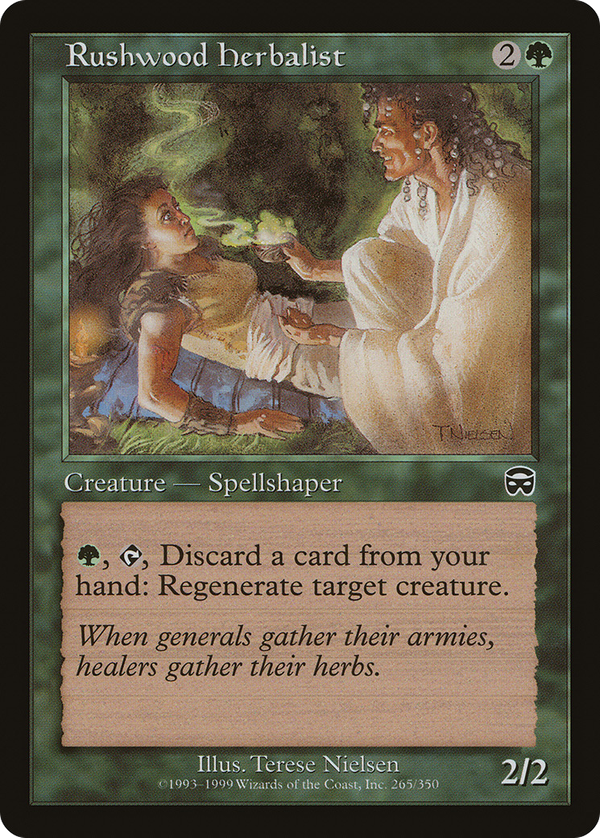
Regeneration was once a shield you bought once and cast at instant speed; bolting it onto a 2/2 body turns it into a faucet you can open every turn, provided you keep feeding it cards. That feed is the cost that keeps the engine from snowballing. Mana-only regenerators saturate a board and grind opponents down for free; here every activation tying back to a discard caps the loop at the size of your grip and forces a genuine trade. You are spending one resource to protect another, a fair exchange that rarely pulls ahead. The result is slow, grinding insurance: cheap when the discarded card is dead weight, painful when it is not. The protection is also narrower than the repeatability suggests, since the activation does nothing against exile, bounce, or destruction that sidesteps regeneration, and the body cannot save itself from much. What this design captured was the era's idea that a one-shot effect could become an ongoing one if you were willing to pay in hand instead of mana: an early experiment in repeatable utility where the discount comes out of the part of your resources you can least afford to keep spending.
Rules text
,  , Discard a card: Regenerate target creature.