Rushwood Grove
A storage land works like a slow-charging battery: each tap deposits a counter, and the counters do nothing on their own until you decide to draw them down all at once. The arithmetic is fair, but the tempo cost is steep. It enters tapped, then spends turns ticking up charges that just sit there, which means the land only earns its keep in a deck patient enough to wait several turns before the payoff lands. The reward is green mana on a turn of your choosing, and the design's one real virtue is granularity: because you remove any number of counters, you can drain the whole reserve for a single explosive turn or siphon off a little at a time. That flexibility doubles as a threat. A land sitting on a visible stack of counters telegraphs the option to dump a fistful of green at instant speed, flashing in a fatty or a pump spell during the opponent's window. What gates the card is not an all-or-nothing clause but the charge time itself: counters accrue one per turn, one tap each, so the reservoir is always several idle turns behind the board. It is a land built to do nothing until it suddenly does a great deal, a bargain most decks correctly decline, and it found a home only in grindy green strategies with nothing more pressing to do with their mana while they stockpiled.
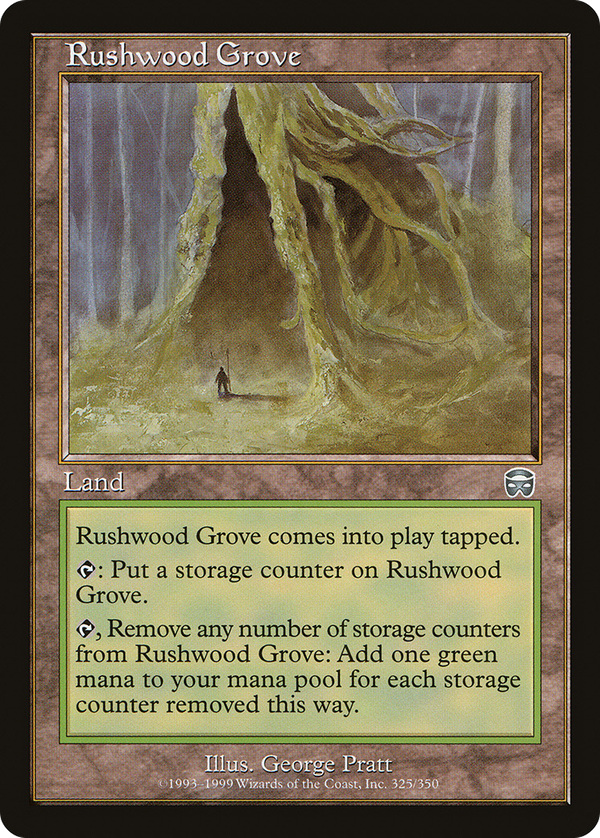
Rules text
 : Put a storage counter on this land.
, Remove any number of storage counters from this land: Add
: Put a storage counter on this land.
, Remove any number of storage counters from this land: Add  for each storage counter removed this way.