Rush of Dread


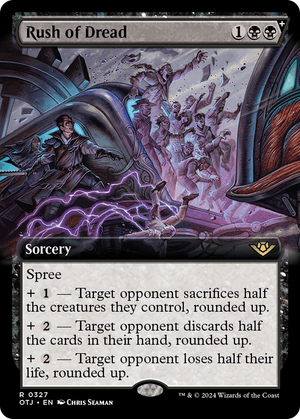
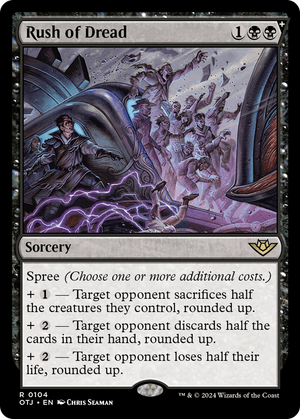
The three classic black tax effects (sacrifice, discard, life loss) have always lived in separate spells, priced individually so that a five-mana Mind Twist and a two-mana Doom Blade never wanted to be the same card. Spree collapses that separation into a single sorcery with an à la carte menu: pay one mode and you have a modest single effect, pay all three and you have wrapped edict, hand attack, and a life-halving finisher into one cast. The safeguard against a strictly-better-everything is that every mode is proportional rather than fixed. Each one takes half of what the opponent has, rounded up, so the spell's bite scales directly with the target's board, hand, and life total. Against an empty board it accomplishes little; against a developed position it can be devastating in a way no fixed-number effect matches. The rounding-up clause is the subtle part of the math: it guarantees the spell always cuts into a nonempty resource, so a lone creature dies, a single card gets discarded, and an odd life total still loses the larger half. That proportional design is what makes stacking the modes worth the mana rather than redundant, because the more the opponent has committed, the harder every half lands at once.
Rules text
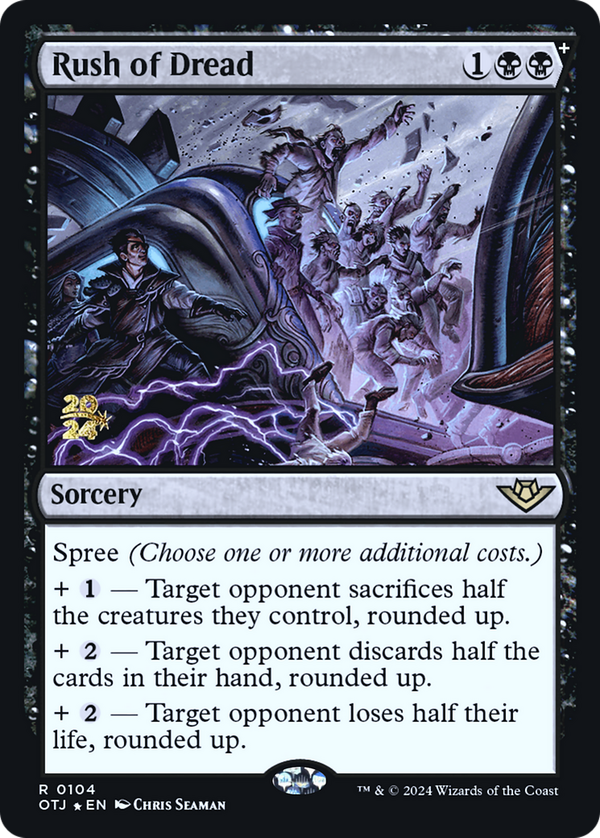
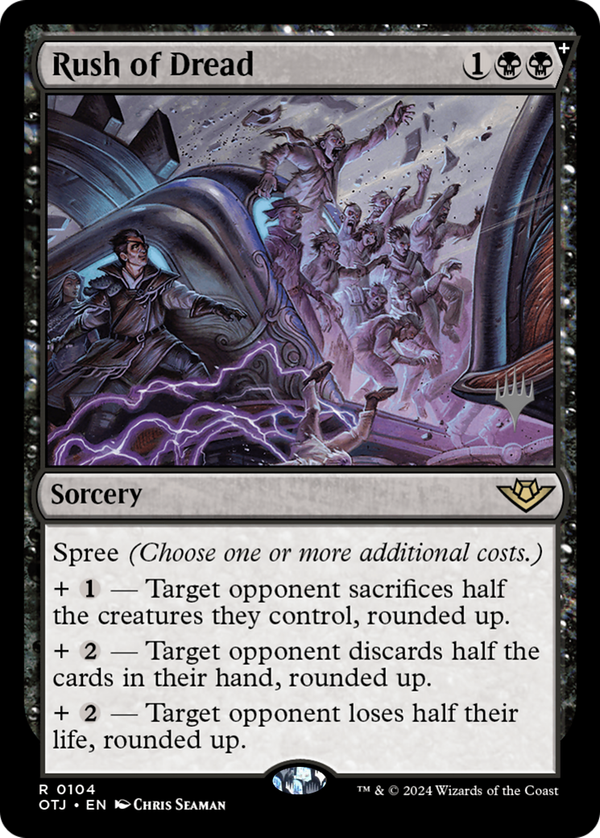
— Target opponent sacrifices half the creatures they control of their choice, rounded up.
+  — Target opponent discards half the cards in their hand, rounded up.
+ — Target opponent loses half their life, rounded up.
— Target opponent discards half the cards in their hand, rounded up.
+ — Target opponent loses half their life, rounded up.