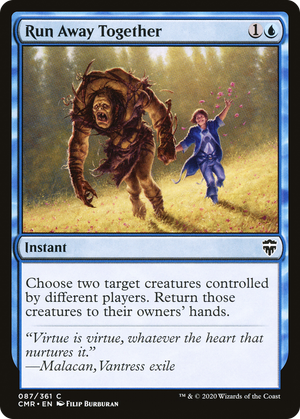
Run Away Together


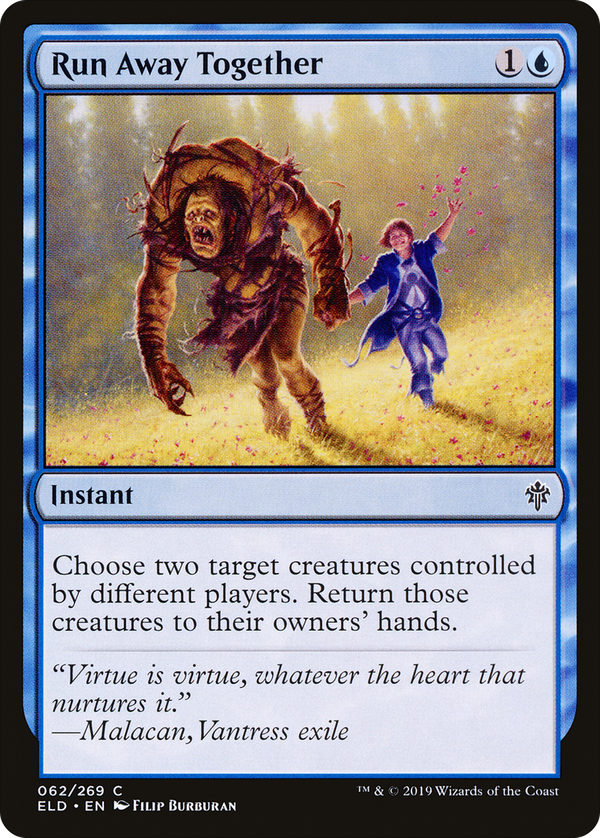
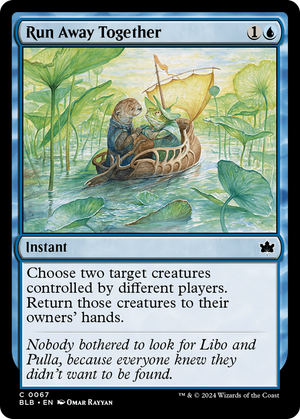
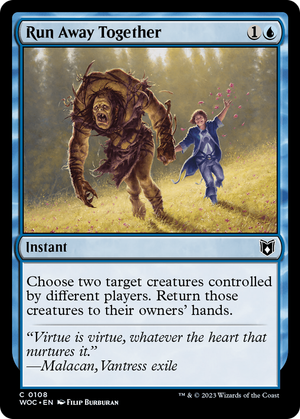
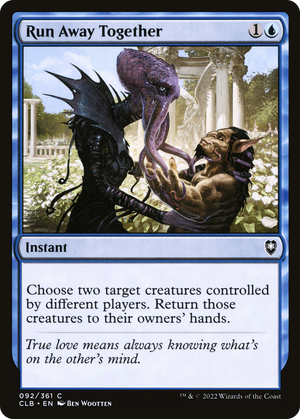
The clause that makes this bounce spell strange is the one forcing you to hit two creatures controlled by different players. It is not a tempo tool in the mold of Vapor Snag or Unsummon: those let you set your own board back at will, protect a creature, or reset a token you want to re-cash. Here the split-controller requirement means you can never simply return your own attacker to save it in a duel, and you can never fully reset a single opponent, because the second target has to belong to somebody else. That constraint pushes the card away from one-on-one play entirely and toward multiplayer tables, where the two-controller rule is a feature rather than a tax: you can bounce a commander off one opponent and a game-ending threat off another, keeping your own board untouched while trading only their tempo. If you would rather include yourself, you can, resetting a valuable enters-the-battlefield trigger of your own alongside the removal-adjacent effect, but nothing about the text obligates it. The wrinkle cuts the other way too. In a spot where only one player has developed a creature worth touching, the second required target may be one you would rather leave alone, or you may have no legal second creature at all and be unable to cast it. It is a design that reads like a plain blue instant and behaves like a negotiation, an asymmetry that only makes sense at a table of more than two.