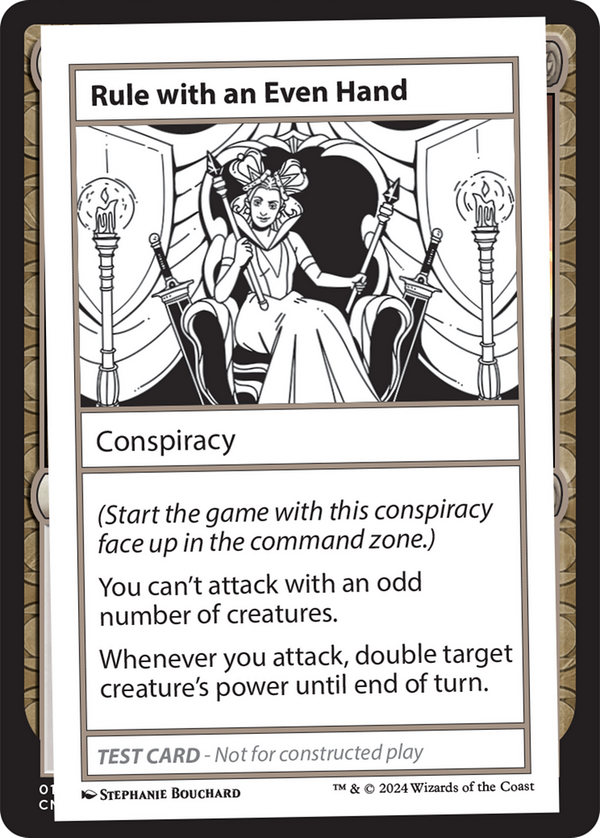
Rule with an Even Hand
Conspiracies are draft's answer to a question no other card type asks: what if the deckbuilding decision happened before you ever cast a spell? This one lives entirely in that pregame space, a rule you agree to play under in exchange for a repeatable payoff. The constraint carries the whole design: you can't attack with an odd number of creatures, which turns every combat step into a parity puzzle. Want to swing with three? You either hold one back or find a fourth. And because one is itself an odd number, you can never send a lone attacker at all: the doubling only fires when at least two creatures are already declared, so the card refuses the very single-threat lines its power boost seems to invite. That tension is the point. You want to aim the doubling at one evasive body, but the even-count rule drags a second creature into every attack, forcing you to build a board that can spare bodies in pairs rather than commit them one at a time. Like all conspiracies, it never gets cast, never sits on the stack, and never draws a removal spell; it simply is, from the first upkeep to the last, an ambient law of your table for the whole game, less a card you play than a house rule your deck signed off on before turn one.